



Federal agencies are ‘prosecutor, judge, and jury’
Justice in America calls for a trial by jury of one’s peers.
There are exceptions allowed by rule, such as for minor traffic offenses and such.
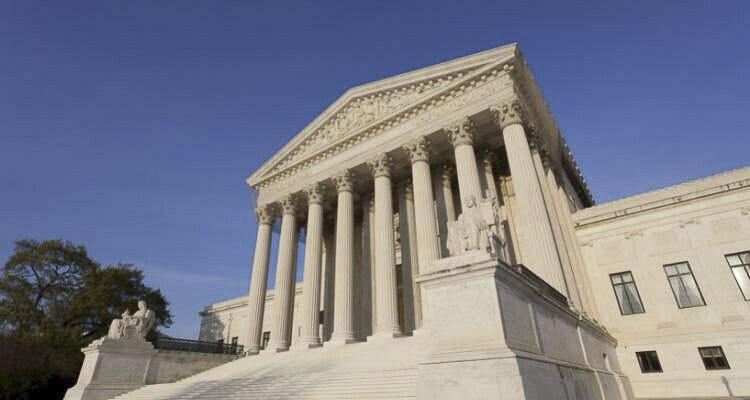
But there’s a new idea now, “trial by bureaucrat,” and the U.S. Supreme Court has agreed to review whether that is permissible.
It is the Institute for Justice that confirmed the court will take up Jarkesy v. SEC.
Jarkesy is a case that contests the legitimacy – and constitutionality – of administrative courts staffed with agency employees.
The IJ said it has similar challenges under way in courts regarding Department of Labor in-house agency courts on behalf of small business owners in New Jersey and Maryland.
“Joe Marino, owner of Sun Valley Orchards, is fighting against devastating penalties imposed by a Department of Labor system that unconstitutionally acts as prosecutor, judge and jury,” the IJ said.
When it was at the 5th U.S. Circuit Court of Appeals, judges there held that the Securities and Exchange Commission’s use of in-house agency judges to impose fines and penalties on Sun Valley violated the Seventh Amendment.
“The Constitution guarantees the right to trial by jury, not trial by bureaucrat,” explained Rob Johnson, a lawyer for the IJ.
“But, too often, federal agencies impose fines and penalties in agency courts, where agency employees serve as prosecutor, judge, and jury. That should frighten all Americans, but it is particularly frightening for small businesses, who, with limited resources, are forced to defend themselves for years in agency courts against potentially crushing fines.
“Now, with the Supreme Court poised to consider these issues, small businesses ensnared in agency courts can hope for relief.”
The organization sued the Department of Labor in 2021 on behalf of Sun Valley Farms, a family owned farm in New Jersey when a bureaucrat imposed over half a million dollars in fines and penalties, most of it based on a simple paperwork mistake.
The attack ended up forcing the family to sell what had been one of the largest family owned farms in New Jersey.
Then this year IJ began a similar case on behalf of C.S. Lawn & Landscape, Inc., of Maryland. That contests $55,000 in liability imposed by a DOL agency judge.
Both of those are before district courts right now.
The IJ pointed out under Article III of the U.S. Constitution, Sun Valley, C.S. Lawn, and George Jarkesy should have had their arguments reviewed federal courts, and federal judges, not agency bureaucrats.
“Agency courts arose in the 1970s, and their use to impose fines and take people’s property expanded rapidly, but the Supreme Court has never really addressed whether all that should instead happen in a real court,” said IJ lawyer Bob Belden. “Agency judges constitutionally can do things like process claims for social security benefits, but if a federal agency wants to fine you tens of thousands of dollars, it should have to prove its case in a real court with a real judge and a jury.”
Also read:
- Ridgefield to host Division I baseball game between UW Huskies and UP Pilots on April 21
 The Ridgefield Outdoor Recreation Complex welcomes two Division I teams this April, offering free entry for local youth players and a rare college matchup in Clark County.
 - Clark County Sheriff shares his concerns with Washington’s new sheriff’s law
 Sheriff John Horch criticizes a new state law allowing a commission to remove elected sheriffs through decertification, arguing it undermines voter authority.
 - VIDEO: Decertified WA sheriffs can now be ousted under controversial new law
 A new Washington law lets an unelected board remove elected sheriffs or police chiefs for misconduct that costs them state certification, raising concerns about free speech and political consequences.
 - Inmate with pending charges in Clark County escapes Western State Hospital
 Joshua Dylan Rice, a Clark County inmate facing robbery and assault charges, escaped Western State Hospital and may have ties to Salmon Creek and North Bend, Oregon.
 - With more state financial stress on horizon, Ferguson signs WA budget
 Washington’s latest $79.4 billion state budget taps rainy day funds, reduces child care provider payments, and defers big tax collections, setting up a deficit in 2028.
 - Gov. Ferguson signs controversial law tightening standards for WA sheriffs
 Sheriffs must now meet strict standards or risk removal, with local officials appointing replacements instead of voter recall, amid ongoing debate over constitutionality.
 - Opinion: Stalin would be proud – Clark County Socialists gathered for ‘No Kings’
 Reform Clark County’s Rob Anderson criticizes local and national groups for organizing protests that featured Auditor Greg Kimsey as a keynote, raising concerns about public trust and political partisanship.
