



The upcoming training course is seven weeks, on Sunday afternoons, Oct. 16 through Nov. 27
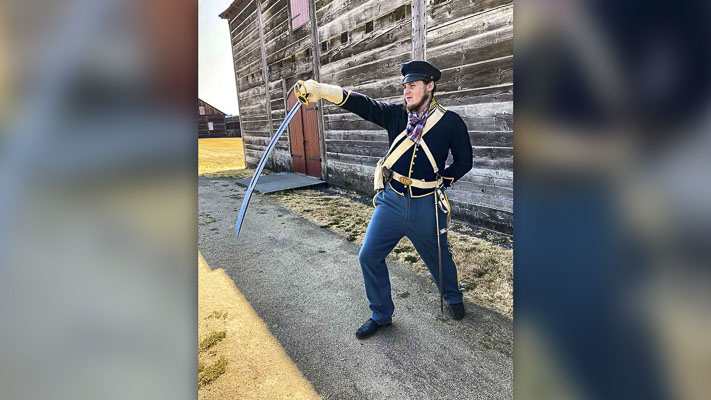
In December of 1855 nearly 100 troopers and officers of the U.S. Army’s 1st Regiment of Dragoons arrived at Fort Vancouver to help keep peace in the region. Dragoons were mounted infantry who carried a variety of personal weaponry, including sabers, a single-edged, slightly curved sword.
To provide the public with hands-on experience of daily life as a trooper, Fort Vancouver National Historic Site, in partnership with Academia Duellatoria, is holding training sessions in the methods and drills used in the 19th century to instruct in the use of this distinctive weapon.
“We are really pleased to start another seven-week series of training sessions. Training and drills for sword work are similar to other martial arts techniques, and so provide opportunity to work on muscle memory, motor skills and coordination. It’s a great way to get exercise, learn some regional history and do something fun and unusual on your own or with your family. Plus, if you choose, after completion of the Basic 1 course you can participate in saber drills during reenactment events at Fort Vancouver,” according to Elaine Dorset, supervisor of the Saber Training Program.
The upcoming training course is seven weeks, on Sunday afternoons, Oct. 16 through Nov. 27. The cost is $100 per person for the seven-week course. Anyone age 12 and up may participate. Training sabers and safety equipment will be provided. The training sessions take place at Fort Vancouver National Historic Site. To learn more visit 19th Century Saber Training Program – Fort Vancouver National Historic Site.
Information provided by Fort Vancouver National Historic Site.
Also read:
- VIDEO: WA income tax signed into law with legal challenge right behind
 A 9.9% income tax affecting high earners in Washington faces swift legal opposition and a proposed citizen initiative seeking repeal.
 - Income tax signed in Washington with a legal challenge close behind
 A new law will tax households earning over $1 million, with funds aimed at expanding credits for lower-income residents. Lawsuits and challenges are already underway.
 - Peter Silliman announces candidacy for Clark County Council
 Peter Silliman, small business owner and Charter Review Commissioner, is seeking the District 5 seat and promises action on transparency, housing, and park development.
 - Opinion: Defend bail now or face more chaos on our streets
 A proposed Washington court rule would cap bail for most misdemeanors and allow defendants to bypass bondsmen, raising concerns about accountability and public safety.
 - County seeking young people to fill 10 volunteer positions on Youth Commission
 Young people ages 12-19 from across Clark County can now apply for at least 10 open seats on the Youth Commission, providing input on community decisions.
 - State Representatives McClintock and Ley answer questions at town hall in Battle Ground
 Residents voiced rising concerns about property taxes, school funding debates, the impact of new income tax legislation, and major costs tied to the Interstate Bridge plan.
 - As Washington gets an income tax, the fight to overturn it begins
 Opponents are organizing lawsuits and potential ballot measures to challenge the new 9.9% income tax on Washington households earning over $1 million.
