



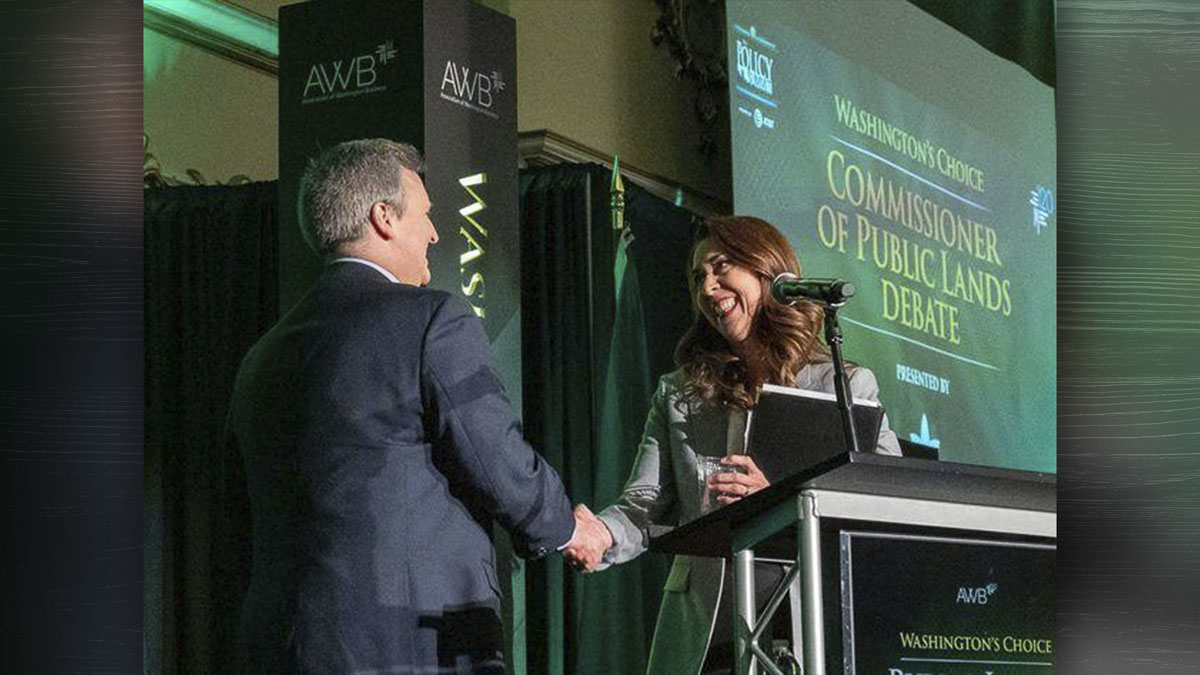
What looked to be a two-Republican matchup on election night now features former Congresswoman Jaime Herrera Beutler of southwest Washington against King County Council Member Dave Upthegrove
Sue Lani Madsen, contributor
The Center Square Washington
After a race for second place that was too close to call until a mandatory hand recount, partisanship came back into the race for Commissioner of Public Lands.
What looked to be a two-Republican matchup on election night now features former Congresswoman Jaime Herrera Beutler of southwest Washington against King County Council Member Dave Upthegrove.
Sue Kuehl Pederson, the endorsed Republican candidate in the race, was defeated by 51 votes by Upthegrove, a Democrat who served in the state House of Representatives from 2002 to 2013.
At a Wednesday debate in Spokane sponsored by the Association of Washington Business, Herrera Beutler and Upthegrove exhibited a cordial relationship. Each candidate emphasized the need to manage state lands for all Washingtonians and to focus on forest health.
Herrera Beutler complimented several initiatives started by the current Commissioner of Public Lands, Democrat Hillary Franz, who left the position to run for Congress in the 6th Congressional District. Franz placed third in the primary.
Upthegrove noted he agreed with much of what his opponent said on the value of healthier forests in reducing wildfire risk.
The primary point of contention between the two candidates was over the management of areas in western Washington identified as legacy forests.
The term is used to describe lands that have regenerated naturally after being logged prior to World War II. These areas are not protected as old growth.
Herrera Beutler said she was opposed to pulling more land out of active management and supported sustainable harvest.
“The set it aside, leave it and walk away model has been proven not to work,” she said.
She advocated relying on recommendations for sustainable timber harvest from forest health experts at the Department of Natural Resources. This would provide timber to the pulp and timber industry and open the canopy to bring sunlight to the forest floor.
Upthegrove agreed that a strong wood products industry is critical. He described his intention to maintain the industry at the same level by harvesting other parcels in the same taxing district in lieu of school trust lands. He intends to use other funds to purchase this additional land for timber harvest.
He did not identify the source of funds or location of the alternative parcels during the debate.
Both emphasized their past experience in making hard decisions and saying “no.” The two agreed that an open-door policy to listen to constituents is necessary and noted the positive side of traveling the entire state during the campaign.
The full debate is available on TVW.
This report was first published by The Center Square Washington.

Also read:
- 49th Legislative District Democrats share their reasons for backing state income tax at Town Hall
 Three Democrat legislators defended the new income tax affecting only those earning over $1 million annually.
 - Letter: Freeze the scope and build the bridge
 Vancouver resident calls for project discipline after 22 years of planning and nearly half a billion in costs.
 - Opinion: Public workers’ First Amendment rights are getting attention – in Idaho, not Washington
 Idaho moves to stop public schools from collecting union dues through government payroll while Washington continues favoring unions over worker choice.
 - Opinion: Lawsuit filed against the unconstitutional income tax in Washington state
 Former Attorney General Rob McKenna and Supreme Court Justice Phil Talmadge challenge the 9.9% income tax in Klickitat Superior Court.
 - Letter: ‘Oregon and Washington aren’t refusing to clean their rolls — they’re contesting federal jurisdiction and timing’
 Camas resident challenges Lars Larson’s fraud claims, explaining legal disputes over federal jurisdiction.
