



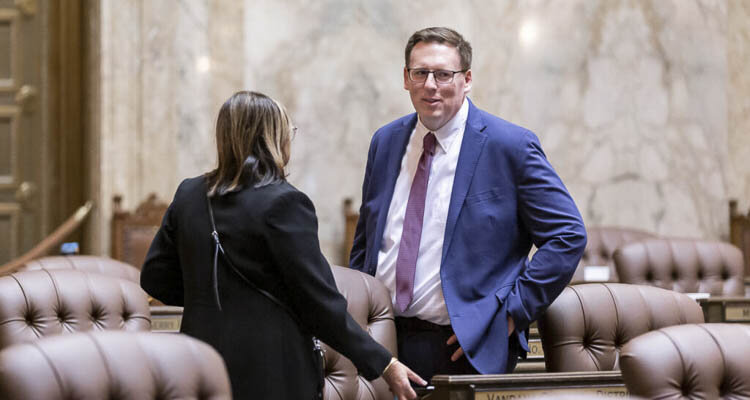
House Bill 2260 authorizes the Liquor and Cannabis Board (LCB) to impose civil penalties on store clerks for selling alcohol to minors
A bill from Rep. Kevin Waters that will align the penalties for selling alcohol to a minor in Washington, is set to become law later this year after the governor signed the bill on Wednesday.
House Bill 2260 authorizes the Liquor and Cannabis Board (LCB) to impose civil penalties on store clerks for selling alcohol to minors.
Under current law, the penalties associated with selling to a minor vary depending upon the seller’s occupation or location. Servers and bartenders have administrative penalty options that are a component of the mandatory alcohol server training.
However, there is no administrative penalty option for store clerks. Instead, they receive a citation for a gross misdemeanor. Additionally, the likelihood that these charges are filed varies by county, leaving some with no penalty at all, and others with a criminal record that may hamper their ability to find another job.
“This bill is about bringing consistency and fairness for store clerks and bartenders or servers,” said Waters, R-Stevenson. “Making sure alcohol is not sold to minors is one of the top priorities for stores and this bill will create parity for stores and restaurants and correct the penalty structure.”
Under the new law, the option for a criminal penalty will remain in effect for cases of intentional or repeat sales to minors. However, adding the option for administrative penalties will harmonize the penalties for store clerks with restaurant servers, and for store clerks found to have sold tobacco products to minors.
“One of the greatest contributors to alcohol consumption by minors is adults securing alcohol for them. Because the law only provides for criminal enforcement for sales to minors that occur in stores, there is a lot of enforcement that is not occurring because law enforcement does not have the capacity to deal with these violations,” said Waters.
“Even with the potential of a misdemeanor, some prosecutors will not work on these cases. This bill will decriminalize unintentional sales to minors for store clerks by implementing the same fine that exists for restaurant employees. Administrative penalties are a way to bring consistency and remove criminal penalties for someone that makes a mistake.”
The bill is scheduled to become law in June of this year, 90 days after the 2024 session adjourned on March 7.
Information provided by Washington State House Republicans,
houserepublicans.wa.gov
Also read:
- Vancouver Police arrest barricaded man
 Terry Meyers, 58, faces multiple assault charges after pointing firearm at neighbor and barricading himself.
 - 49th Legislative District Democrats share their reasons for backing state income tax at Town Hall
 Three Democrat legislators defended the new income tax affecting only those earning over $1 million annually.
 - Letter: Freeze the scope and build the bridge
 Vancouver resident calls for project discipline after 22 years of planning and nearly half a billion in costs.
 - Ekklesia Theatre presents ‘Every Brilliant Thing’
 Interactive theatre production donates 50% of ticket sales to local counseling services.
 - Opinion: Public workers’ First Amendment rights are getting attention – in Idaho, not Washington
 Idaho moves to stop public schools from collecting union dues through government payroll while Washington continues favoring unions over worker choice.
 - Opinion: Lawsuit filed against the unconstitutional income tax in Washington state
 Former Attorney General Rob McKenna and Supreme Court Justice Phil Talmadge challenge the 9.9% income tax in Klickitat Superior Court.
 - Vancouver Police investigate domestic violence homicide
 Vancouver Police Major Crimes Unit investigating after woman found dead with knife wounds on NE Oakbrook Circle.
