



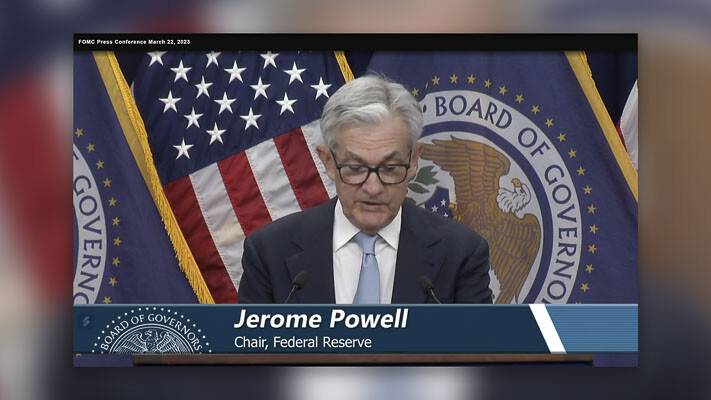
The latest hike moves it to a range of 4.75 to 5 percent, according to the central banking system’s website
Casey Harper
The Center Square
The Federal Reserve announced a key interest rate hike Wednesday, the ninth time it has done so since early 2022 in its effort to combat rising inflation.
The rate got a quarter-point increase to 0.25% to 0.5% on March 17 of last year; the latest hike moves it to a range of 4.75% to 5%, according to the central banking system’s website. Another hike, perhaps a final one in this trend according to policymakers, could move it to 5.1%.
“Recent indicators point to modest growth in spending and production,” the Federal Reserve Board of Governors said in a statement. “Job gains have picked up in recent months and are running at a robust pace; the unemployment rate has remained low. Inflation remains elevated.”
Government reports say 311,000 jobs were added in February, and unemployment rose from 3.4% to 3.6%.
Inflation has soared in the last two years, making everyday goods and services more expensive for Americans. The Feds’ key interest rate was 1% to 1.25% when the impact of COVID-19 slammed the country in early March 2020, and the rate dropped to 0 to 0.25% on March 16, 2020. In the next two years, stimulus and relief funds flowed into the economy as businesses struggled amid lockdowns and mandates; the rate stayed low until inflation took off last spring.
Some experts feared that the recent bank collapses would make the economy too frail to withstand the rate hike, which are aimed at lowering inflation at a cost to economic growth.
“The [Federal Reserve] should pause on Wednesday,” Bill Ackman, CEO of Pershing Square, wrote on Twitter ahead of the news. “We have had a number of major shocks to the system. Three US bank closures in a week wiping out equity and bond holders. The demise of Credit Suisse and the zeroing of its junior bondholders.”
Because of the recent economic scares, others called for an actual decrease in interest rates. The Federal Reserve seemed to acknowledge those concerns in its announcement.
“In assessing the appropriate stance of monetary policy, the committee will continue to monitor the implications of incoming information for the economic outlook,” the group said. “The committee would be prepared to adjust the stance of monetary policy as appropriate if risks emerge that could impede the attainment of the committee’s goals. The committee’s assessments will take into account a wide range of information, including readings on labor market conditions, inflation pressures and inflation expectations, and financial and international developments.”
This report was first published by The Center Square.
Also read:
- Former WA Supreme Court justice joins legal effort against income tax
 Phil Talmadge and Rob McKenna have joined forces with the Citizens Action Defense Fund to oppose Washington’s new tax on high-income earners, raising legal and constitutional questions.
 - Makeover in store for Congress with flood of lawmakers headed for the exits
 A wave of exits from Congress—over 65 lawmakers—will usher in unfamiliar faces and decrease veteran expertise, shifting the political landscape in Washington.
 - Opinion: Sheriffs fight back
 Four county sheriffs are suing to block a new law giving a governor-appointed board power to decertify and remove sheriffs, bypassing voter oversight in Washington.
 - Obituary for Lucille ‘Erma’ Christenson Madore – April 22,1924-March 13, 2026
 Known for her love of music and family, Lucille ‘Erma’ Christenson Madore lived through nearly 102 years and leaves a large, grateful legacy in Vancouver.
 - Fiscal fallout: $375 million bond debt indirectly funding operating budget
 Shifting $375 million from a loan fund impacts local infrastructure as Washington state covers operating costs with bond debt, prompting concern among officials and advocacy groups.
 - Lawsuit aims to block new eligibility requirements for WA sheriffs
 Four sheriffs are suing over a state law that sets new eligibility rules, arguing it undermines voter authority by allowing removal for certification issues.
 - Opinion: The growing gap between public voice and political power
 Todd Myers describes how large-scale protest and sign-ins often fail to sway state leaders, and argues authentic influence is most likely found through local action.
