



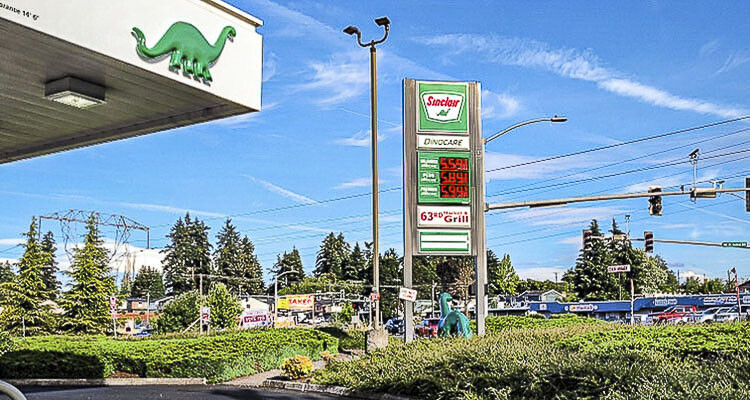
Some state policy experts think there’s a legislative component to the high cost of Washingtonians’ fuel, citing the state’s new cap-and-trade carbon tax program
Timothy Schumann
The Center Square Washington
Despite falling prices two weeks in a row, fuel prices are up nearly 30% in the last six months in Washington state, which still takes home the title of most expensive fuel pricing nationwide.
The average price of a gallon of regular unleaded was $4.93 on Monday, down from $4.96 the week prior, according to AAA data. This price drop marks only the fourth week this year of declining fuel prices for Washingtonians, following the implementation of the new carbon tax earlier this year.
This three-cent per gallon decrease moved opposite the national average, which rose from $3.54 to $3.56 per gallon, a two-cent increase over the same time period.
“Gas demand has fallen nearly 10 percent since the holiday, as folks have returned to their day-to-day driving routines,” said AAA spokesperson Andrew Gross in a statement. “Typically, this would lower gas prices, but such a move is being countered for now by the increasing cost for oil, the main ingredient in gasoline.”
Washington’s $4.93 per gallon places it $1.37 per gallon higher than the national average of $3.56 per gallon. It is also $1.93 per gallon above the nation’s least expensive fuel costs of $3.00 per gallon, currently paid by Mississippi residents.
In Washington, intra-state variance remains high at $1.25 per gallon, up eight cents per gallon from the week prior. The outliers this week, again San Juan and Asotin counties, represent the most and least expensive gas prices statewide at $5.51 and $4.26 per gallon, respectively.
This price variance still largely follows the Cascade Range, with residents to the west paying a higher premium at the pump than residents to the east.
Some state policy experts think there’s a legislative component to the high cost of Washingtonians’ fuel, citing the state’s new cap-and-trade carbon tax program implemented Jan. 1 of this year.
With the second carbon auction completed May 31, and the results announced June 7, one of those experts thinks that the legislative component added by cap-and-trade may be as high as 45 cents per gallon.
“Although Washington is paying more for CO2 emissions than California, that additional cost doesn’t help the environment – it just harms our economy,” said Todd Meyers of the Washington Policy Center in a recent report.
One Democrat, Senator Mark Mullet, agrees this price is too high, having recently introduced state legislation to cap the price of these auctions.
“The whole idea all along has been that our price for a permit for a ton of carbon should line up with California’s – instead we’re nearly double California’s price,” said Mullet in a statement accompanying the announcement of the legislation.
Gov. Jay Inslee disagrees on where the blame lies, calling the “author of these prices [the] oil and gas companies,” and calling on the Legislature to instead “look [into] this issue.”
The third carbon auction is set to take place on Aug. 30 of this year.
T.J. Martinell contributed to this report. This report was first published by The Center Square Washington.
Also read:
- Opinion: In plain sight – yielding to pedestrians
 Drivers often fail to see pedestrians due to inattentional blindness, which highlights the need for more focused awareness at intersections and stronger safety practices.
 - Expect delays on SR 14 in Vancouver for guardrail repairs Wednesday
 State Route 14 travelers in Vancouver should plan for morning delays as WSDOT will close two eastbound lanes for guardrail repairs, affecting mileposts 6.0 to 7.0.
 - Overnight closure planned on westbound SR 14 Camas Slough Bridge Tuesday
 WSDOT crews will close westbound SR 14 at Exit 14 in Camas to collect bridge deck samples and plan future repairs; detours will be in effect.
 - Opinion: Stay in your lane – seriously, it’s the law
 Drivers must choose the nearest lane when turning in Washington, and left turns bring added risk. Even with signals, every driver must help prevent crashes by following law.
 - POLL: After hearing state leaders describe the I-5 Bridge as vulnerable in an earthquake, what is your reaction?
 State and local leaders describe the I-5 Bridge as structurally at risk but recommend drivers continue crossing it while complex replacement plans unfold.
