



The program provides a financing mechanism to encourage the installation of renewable energy systems, energy efficiency improvements, and resiliency improvements
VANCOUVER – The Clark County Council last week approved an ordinance to implement a commercial property assessed clean energy and resiliency (C-PACER) program. The program provides a financing mechanism to encourage the installation of renewable energy systems, energy efficiency improvements, and resiliency improvements on large multi-family residential, industrial, agricultural and commercial properties.
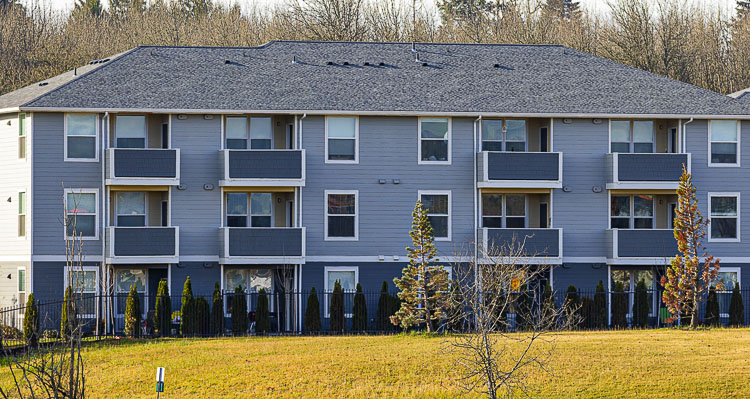
Eligible improvements must reduce greenhouse gas emissions, reduce water consumption, reduce energy consumption, improve seismic resiliency, reduce stormwater or pollution, or reduce the risk of wildfire, flooding or other natural- or human-caused disaster.
C-PACER programs allow a property owner to finance the up-front cost of these improvements on a property and then pay it back over time through a property assessment. Collection and enforcement of the C-PACER lien and financing payments, including foreclosure, is the responsibility to the capital provider. An engineer or other qualified professional must certify that the improvements qualify for the program; county staff will not independently make this determination.
To obtain C-PACER financing, the property owner must submit an application to Clark County Community Development showing the proposed improvements, certification that the improvements qualify for the financing, and other requirements. The county will then record each C-PACER lien in real property records. The lien will then run with the land.
“The county is excited to implement a program that will benefit local property owners and simultaneously encourage positive environmental building practices,” said County Chair Eileen Quiring O’Brien.
The Washington State Legislature in 2020 approved HB 2405 authorizing C-PACER programs in the state.
More information is on the county’s website at https://clark.wa.gov/sites/default/files/media/document/2021-10/2021-10-04.pdf.
Information provided by Clark Co. WA Communications.


WHAT A WASTE of money!
Look at real data and recognize the fact that the “climate crisis” is the biggest scam in human history!
Here are some true climate facts:
• There has been less than one degree of warming from 1850 to 2012
• Man emits 6% of CO2 emissions, nature 94%
• CO2 causes ONLY about 1/3 of the warming.
• There is no evidence that hurricanes have increased
• There is no evidence that storms have increased
• There is no evidence that sea level rise has increased
• There is no evidence that floods have increased
• There is no evidence that droughts have increased
• It is not possible to predict future climate.
(Evidence is below)
Fact is that there is nothing unusual about today’s climate and thus nothing to explain with man’s CO2. This well respected source debunks several popular lies about climate:
Here are Quotes & Facts from the IPCC (which is considered the bible of climate), NASA & the Bulletin of the American Metrological Society.
(You may have read other claims from the IPCC, usually from the Summary For Policy Makers without knowing that the summary is actually a political document written, word by word, by politicians from many countries including those looking for cash handouts. The below is from the science part of the report.)
1. Earth only warmed 0.78 degree C up to 2012.
“Using Had-CRUT4 and its uncertainty estimates, the warming from 1850–1900 to 1986–2005 (reference period for the modelling chapters and Annex I) is 0.61 [0.55 to 0.67] C (90% confidence interval), and the warming from 1850–1900 to 2003–2012 (the most recent decade) is 0.78 [0.72 to 0.85] C (Supplementary Material 2.SM.4.3.3).”
Pg. 209 of https://www.ipcc.ch/site/assets/uploads/2018/02/WG1AR5_all_final.pdf
2. Man emits about 6% of total emissions.
Add the numbers on this NASA diagram: https://earthobservatory.nasa.gov/features/CarbonCycle/page1.php
3. CO2 causes only about 26-32% of the greenhouse effect. H2O causes 60-75%.
https://en.wikipedia.org/wiki/Greenhouse_effect#Greenhouse_gases which is based on Table 3 of: Bulletin of the American Meteorological Society Vol. 78, No. 2, February 1997 –
http://journals.ametsoc.org/doi/pdf/10.1175/1520-0477%281997%29078%3C0197%3AEAGMEB%3E2.0.CO%3B2
4. We do not have enough data to say that hurricanes have increased.
“Confidence remains low for long-term (centennial) changes in tropical cyclone activity, after accounting for past changes in observing capabilities.”
pg 178 of https://www.ipcc.ch/site/assets/uploads/2018/02/WG1AR5_all_final.pdf
5. We do not have enough data to say that storms have increased.
“Confidence in large-scale trends in storminess or storminess proxies over the last century is low owing to inconsistencies between studies or lack of long-term data in some parts of the world (particularly in the SH). {2.6.4}”
pg 178 of https://www.ipcc.ch/site/assets/uploads/2018/02/WG1AR5_all_final.pdf
6. No evidence that normal sea level increase has accelerated.
(Note that sea levels have been rising since the end of the last ice age – the issue is whether it is rising faster.)
“When a 60-year oscillation is modeled along with an acceleration term, the estimated acceleration in GMSL since 1900 ranges from: 0.000 [–0.002 to 0.002] mm yr–2 in the Ray and Douglas (2011) record, 0.013 [0.007 to 0.019] mm yr–2 in the Jevrejeva et al. (2008) record, and 0.012 [0.009 to 0.015] mm yr–2 in the Church and White (2011) record. Thus, while there is more disagreement on the value of a 20th century acceleration in GMSL when accounting for multi-decadal fluctuations, two out of three records still indicate a significant positive value. The trend in GMSL observed since 1993, however, is not significantly larger than the estimate of 18-year trends in previous decades (e.g., 1920–1950). “
Page 306 of https://www.ipcc.ch/site/assets/uploads/2018/02/WG1AR5_all_final.pdf
7. No evidence that floods have increased (per IPCC)
“AR4 WGI Chapter 3 (Trenberth et al., 2007) did not assess changes in floods but AR4 WGII concluded that there was not a general global trend in the incidence of floods (Kundzewicz et al., 2007). SREX went further to suggest that there was low agreement and thus low confidence at the global scale regarding changes in the magnitude or frequency of floods or even the sign of changes.”
pg 230 of https://www.ipcc.ch/site/assets/uploads/2018/02/WG1AR5_all_final.pdf
8. No evidence that droughts have increased
“Confidence is low for a global-scale observed trend in drought or dryness (lack of rainfall) since the middle of the 20th century, owing to lack of direct observations, methodological uncertainties and geographical inconsistencies in the trends.”
pg 178 of https://www.ipcc.ch/site/assets/uploads/2018/02/WG1AR5_all_final.pdf
9. Prediction of future climate is not possible.
“The climate system is a coupled non-linear chaotic system, and therefore the long-term prediction of future climate states is not possible. “ https://www.ipcc.ch/ipccreports/tar/wg1/501.htm (IPCC third Assessment Report (2001) Section 14.2.2.2, page 774) and Page 771, https://www.ipcc.ch/site/assets/uploads/2018/03/TAR-14.pdf
This shows that THERE IS NO CLIMATE EMERGENCY.
Also see: http://www.debunkingclimate.com/arguements.html
http://icecap.us/index.php/go/political-climate/alarmist_claim_rebuttals_updated/
