



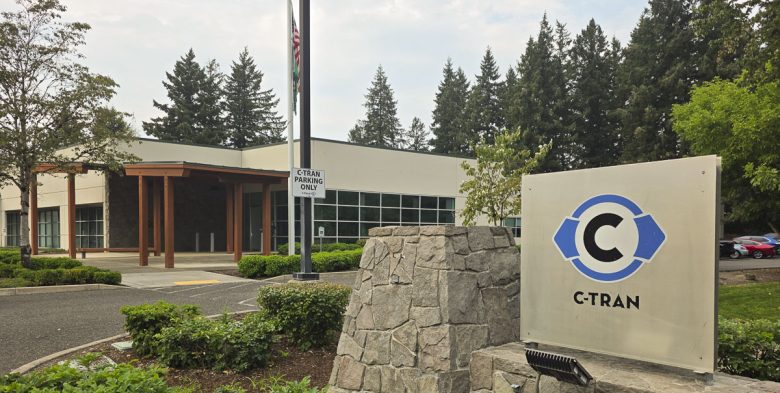
There are likely to be legal challenges, but the C-TRAN Board Composition Review Committee voted for a 4-3-2 format for the C–TRAN board — four seats to the City of Vancouver, three to Clark County, and two to be shared by the smaller cities — with two major conditions
Paul Valencia
Clark County Today
Members of the C-TRAN Board Composition Review Committee came up with a compromise Tuesday night, but some have already wondered if the action will survive legal challenges.
“Potentially there will be no further meetings pending litigation,” said Troy MCoy, who chaired the meeting. With a chuckle, he added: “Billable hours are still undefeated.”
The committee passed a motion giving the city of Vancouver four seats on the C-TRAN Board of Directors, three to Clark County, and two to be shared by the smaller cities — but with two major conditions.
The first is that small cities would not fund light rail through current C-TRAN revenues unless voted on by the people of the small cities and/or their city councils.
The second is that the C-TRAN representatives of Clark County cannot come from districts that cover a majority of Vancouver. This, proponents say, would keep Vancouver from having a majority on the nine-member C-TRAN board.
The motion passed 8-2 Tuesday night, but members of the committee noted that both conditions might not pass legal muster.
Erik Paulsen, of the city of Vancouver, said he believed the purview of this group speaks to composition only. He said it is more appropriate for the C-TRAN board to determine if small cities would be exempt from paying for light rail. Glen Yung of Clark County agreed, noting he did not believe the composition review committee could dictate funding.
Meanwhile, Sue Marshall, the chair of the Clark County Council, said she will be consulting with the county’s attorneys to determine the legality of the action.
“I would not be supportive of usurping any of the county’s authority in terms of who we select for any of our boards and commissions,” Marshall said.
Currently, the C-TRAN board is made up of three representatives from Vancouver, two from Clark County, and four representing small cities. Earlier this year, the Washington State Department of Transportation gave notice that C-TRAN was out of compliance with state law, saying that representation needed to be based on population.
The review committee has gone back and forth with several proposals, including a 3-3-3 format (Three for Vancouver, three for Clark County, and three to be shared by the small cities.) The courts are involved in that battle. Some on the committee believe the only way to be in compliance is to go with a 4-3-2 model.
The 4-3-2 model, though, would significantly decrease representation for the smaller cities, with many of those cities concerned with the prospect of having to pay their share for a transportation system — light rail — that would have little or no benefit to its citizens.
Thus, the compromise floated by McCoy.
“The art of compromise is nobody gets everything they want,” McCoy said. “Ultimately, I think I would like to protect C-TRAN. I believe this motion does that.”
He then outlined his motion: The 4-3-2 proposal, in exchange for a requirement that small cities will not fund light rail through current C-TRAN revenues without approval of the voters or their city councils. The seats for the small cities would be broken down into one seat for Camas and Washougal, and one seat for Battle Ground, Ridgefield, and La Center.
Tim Hein, representing Camas, said he would only support such a motion if the Clark County members of the board are residents of Clark County, but not the city of Vancouver. Otherwise, Vancouver would be getting too many votes.
Matt Cole of Ridgefield agreed.
“A member of the County Council serving on the C-TRAN board that is all or mostly in Vancouver could essentially give Vancouver … a representative majority of the board,” Cole said.
He asked for an amendment to McCoy’s motion: The Clark County Council could not send a member of their council to participate on C-TRAN’s board who would come from a district that would give one jurisdiction a majority. In other words, the council could only send a member whose district did not include Vancouver.
That amendment passed 6-4:
In favor: Sean Boyle (La Center), Tim Hein (Camas), Troy McCoy (Battle Ground), Matt Cole (Ridgefield), Matt Little (Clark County), Glen Yung (Clark County)
Against: Wil Fuentes (Clark County), Michelle Belkot (Clark County), Sue Marshall (Clark County), and Erik Paulsen (Vancouver.)
The original motion, with the amendment, was then considered.
Paulsen appreciated the compromise.
“It’s the objective of myself and the Vancouver City Council to keep C-TRAN intact,” he said. “It’s important that we have a regional transportation provider and that means all the cities … can feel adequately represented.”
He said he hoped this motion would pass and he liked that members “found some common ground.”
Cole said he is still a proponent of trying to get the state to accept a 3-3-3 format, but he also appreciates the spirit of how this came about in recent months.
“We do need to get back to doing the business of what is good for everybody in our community,” Cole said. “While this isn’t the best outcome, I think it represents a great compromise. I look forward to getting back to work.”
The vote for the motion and the amendment passed 8-2.
In favor: Sean Boyle (La Center), Michelle Belkot (Clark County), Tim Hein (Camas), Troy McCoy (Battle Ground), Matt Cole (Ridgefield), Matt Little (Clark County), Glen Yung (Clark County), Erik Paulsen (Vancouver).
Against: Wil Fuentes (Clark County), Sue Marshall (Clark County).
This committee was formed to determine the future of the composition of the C-TRAN Board of Directors. Still, it is no secret that one of the biggest issues facing the board is the current language in an agreement that allows C-TRAN to potentially pay for operations and maintenance costs for Oregon’s light rail extension into downtown Vancouver. Small cities, and at least one Clark County councilor, are concerned about taxpayers being forced to help pay for a failing system — TriMet.
In fact, it was Belkot’s intention to vote to change the language, to protect Clark County taxpayers, that got her removed from the C-TRAN board in March. That action remains under legal challenge, and a Skamania County Sheriff’s Report recently ruled that the Clark County Council broke Open Public Meetings Act regulations in removing Belkot and placing Fuentes on the board.
Belkot might not be a member of the C-TRAN board right now, but she is a member of the composition review committee.
“TriMet is going bankrupt. Is there legal implications with trying to do business with a bankrupt entity?” she asked during Tuesday’s meeting. “Why would we want to entangle our Clark County taxpayers with a bankrupt company? That doesn’t make any sense.”
Cole noted that such an argument could be made at a C-TRAN board meeting, not necessarily the composition review committee.
Belkot made her point, though. While the review committee does not make policy for C-TRAN, the composition of the new C-TRAN board will likely face another light rail funding vote in the future.

Also read:
- Clark County Sheriff shares his concerns with Washington’s new sheriff’s law
 Sheriff John Horch criticizes a new state law allowing a commission to remove elected sheriffs through decertification, arguing it undermines voter authority.
 - VIDEO: Decertified WA sheriffs can now be ousted under controversial new law
 A new Washington law lets an unelected board remove elected sheriffs or police chiefs for misconduct that costs them state certification, raising concerns about free speech and political consequences.
 - With more state financial stress on horizon, Ferguson signs WA budget
 Washington’s latest $79.4 billion state budget taps rainy day funds, reduces child care provider payments, and defers big tax collections, setting up a deficit in 2028.
 - Gov. Ferguson signs controversial law tightening standards for WA sheriffs
 Sheriffs must now meet strict standards or risk removal, with local officials appointing replacements instead of voter recall, amid ongoing debate over constitutionality.
 - Opinion: Stalin would be proud – Clark County Socialists gathered for ‘No Kings’
 Reform Clark County’s Rob Anderson criticizes local and national groups for organizing protests that featured Auditor Greg Kimsey as a keynote, raising concerns about public trust and political partisanship.
 wpDiscuz
