



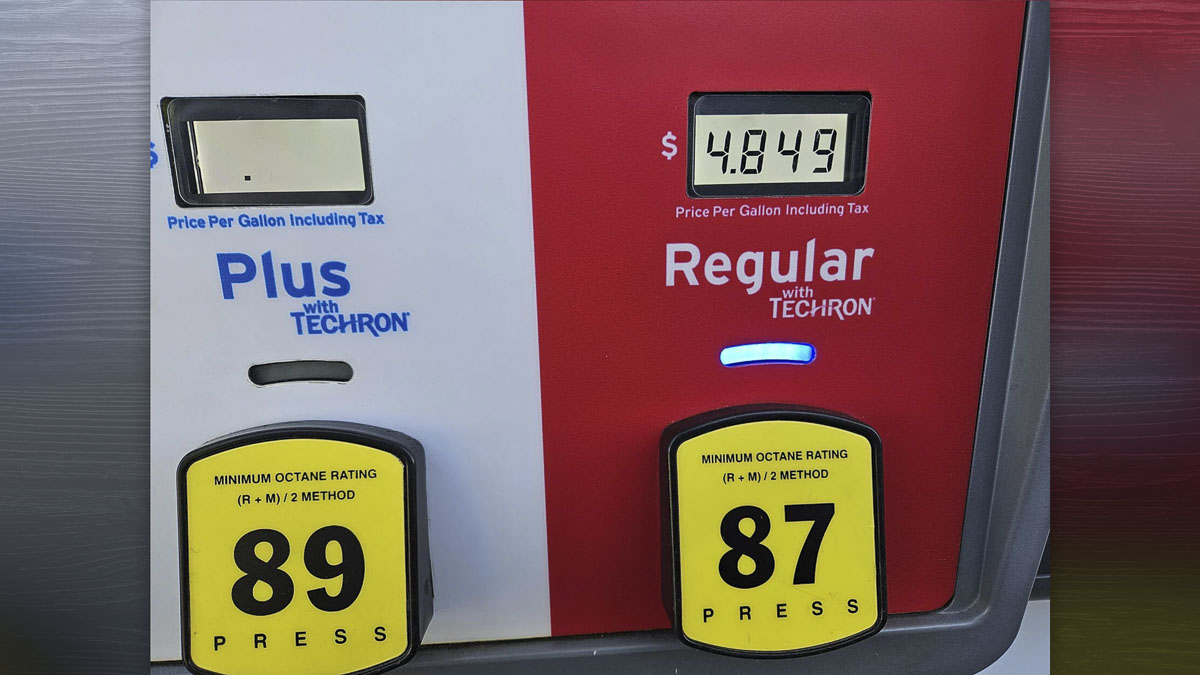
The new gas tax increased the price by 6 cents per gallon, bringing the state’s per-gallon tax rate from 49.4 cents to 55.4 cents
Brett Davis
The Center Square Washington
While gas prices in Washington state fluctuate, they have increased overall compared to last year, with drivers enduring some of the highest fuel costs in the nation.
According to AAA, the average price of standard, or regular grade, gas in Washington is $4.39 per gallon as of Friday morning, up slightly from last week’s $4.388. However, prices have increased substantially compared to last year, when gas was $4.243.
Only California and Hawaii have higher gas prices than Washington.
The national average for a gallon of regular gas is $3.151.
Several factors impact the price of gas in the Evergreen State, including increases in state gas and diesel taxes effective July 1.
The new gas tax increased the price by 6 cents per gallon, bringing the state’s per-gallon tax rate from 49.4 cents to 55.4 cents. To adjust for inflation, per-gallon gas prices will rise 2% every year.
The diesel tax went up 3 cents per gallon at the beginning of July. Diesel will increase by 3 cents more in two years; then in 2028, it will increase by 2% a gallon each year. Factoring in future increases and inflationary adjustments translates into a 9-cent climb from 49.4 cents per gallon to 58.4 cents per gallon.
State lawmakers faced a projected $1 billion shortfall in the two-year transportation budget and an $8 billion gap over the next six years. The deficit was largely attributed to rising construction costs and a decline in gas tax revenue due to increased fuel efficiency and the rise of electric vehicles.
The gas tax increase, along with other revenue measures, is expected to generate approximately $3.2 billion over the next six years, with the gas tax specifically bringing in $1.4 billion over that period.
Also impacting the price at the pump in Washington is the state’s cap-and-trade program, established by the Climate Commitment Act in January 2023 and run by the Washington State Department of Ecology. The program has generated approximately $3.2 billion so far. The money goes to projects that reduce greenhouse gas emissions and promote clean energy initiatives.
Larry Behrens, communications director with the energy advocacy organization Power The Future, didn’t hesitate to express his opinion on Washington’s energy policies related to gas prices.
“While gas prices have dropped across the country over the past year, they’ve actually gone up in Washington state,” he emailed The Center Square on Thursday. “It’s a clear sign of energy mismanagement, especially when Washington drivers are now paying over $4.38 a gallon – more than $1 above the national average. At this point, Washington seems determined to compete with California for the title of most incompetent energy policy in America.”
Andrew Wineke, Washington State Department of Ecology deputy communications director, has a different perspective.
“According to U.S. Energy Information Administration data, gas prices in Washington are about 6 cents a gallon cheaper today than they were a month ago, 60 cents lower than they were in 2023, and 73 cents lower than they were in 2022,” he said in a Thursday email to The Center Square. “That’s despite the 6-cent increase in the gas tax that took effect July 1.”
He added, “Adjusted for inflation, today’s prices are also lower than the equivalent price in 2021.”
Wineke pointed out that Washington often experiences higher gas prices than the national average due to a combination of factors unique to the state and region.
“Gas prices in the Northwest often don’t track national trends because the region is not connected to the rest of the country via pipelines, meaning that nearly all of the fuels used in Washington and Oregon come from the five oil refineries located along Puget Sound,” he explained. “You can see this in Oregon’s fuel prices, which are also higher today than they were in 2024, but lower than they were in 2023 or 2022.”
This report was first published by The Center Square Washington.
Also read:
- VIDEO: Vote-by-mail rules in WA at risk in SCOTUS election law case
 More than 127,000 Washington ballots postmarked by Election Day but received after could be disqualified under a possible Supreme Court ruling, prompting debate from both parties.
 - Rounding out debate, Gov. Ferguson signs bill addressing retailers’ penny problem
 A new Washington law lets merchants round cash purchases to the nearest 5 cents, aiming to manage change as shortages of pennies affect both businesses and customers.
 - Opinion: State is rightly emphasizing experience and skills, not degrees
 Elizabeth New explains how a new state policy removes unnecessary advanced degree requirements, supporting skills-based employment and broadening opportunities for capable workers.
 - Opinion: The wealth migration is real – which states are benefiting?
 IRS data shows Idaho, Montana, and Wyoming attracted significant wealth from new residents, while Washington state saw a loss of $500 million as its new capital gains tax took effect.
 - Expect delays on SR 14 in Vancouver for guardrail repairs Wednesday
 State Route 14 travelers in Vancouver should plan for morning delays as WSDOT will close two eastbound lanes for guardrail repairs, affecting mileposts 6.0 to 7.0.
 - Clark County Fire District 10 responds to fatal structure fire on NE Fargher Drive
 Emergency crews from multiple agencies responded to a structure fire on NE Fargher Drive in Amboy, where two victims lost their lives despite rescue and medical efforts.
 - Opinion: Voting with the Democrat Party – Back to the future!
 Lars Larson connects the history of election rules to today’s debates, highlighting Supreme Court concerns over counting ballots after Election Day.
 wpDiscuz
