



Rent assistance in Clark County is accessed through the Council for the Homeless
One effective way to keep people who get behind in their rent in their homes is to connect them with rental assistance. Rent assistance is designed to help a household weather a temporary challenge in being able to pay their rent.
Rent assistance in Clark County is accessed through Council for the Homeless. The Council and stakeholders, which include Clark County and other housing and homelessness agencies, are moving to an approach that emphasizes making rent assistance availability predictable and accessible to those in need of assistance.
Rent assistance screenings will take place on the 6th and 20th of each month beginning at 12:30 p.m. If either date falls on a holiday, the screening will take place the following business day. This is the case for February where February 20 falls on Presidents Day. The February screening will take place Feb. 21, 2023.
How to apply:
- By phoning the Housing Hotline at (360) 695-9677
- Via online portal in English https://airtable.com/shr2UTp2OIlc6vx7a or Spanish https://airtable.com/shrwY8yx0GlgDGEHG
- People without access to a phone or computer can visit the Housing Solutions Center at 2306 NE Andresen Road, Vancouver, 98661.
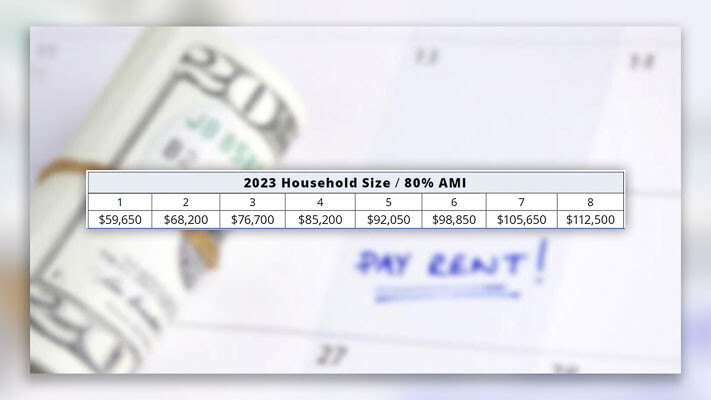
To qualify for assistance, tenants must be behind in the rent by at least one month, and have a total household income of 80% or less than Clark County’s Area Median Income (AMI). This means, for example, that a family of three earning $76,300 per year or less satisfies the income qualification. Previously, the program was limited to those with an income of 60% or less of the AMI.
Financial assistance through the program is one-time per household and does not apply to homeowners who are behind in mortgage payments. Landlords cannot apply for aid on behalf of tenants.
“The new application system addresses concerns we received from tenants during previous rental assistance distributions,” said Sunny Wonder, deputy director, Council for the Homeless. “Now, there are more opportunities to apply for and receive assistance. Our goal is to help as many tenants as possible who have fallen behind in rent remain housed.”
Council for the Homeless is a non-profit organization whose mission is to provide community leadership, compelling advocacy, and practical solutions to prevent and end homelessness in Clark County.
Information provided by the Council for the Homeless.
Also read:
- With more state financial stress on horizon, Ferguson signs WA budget
 Washington’s latest $79.4 billion state budget taps rainy day funds, reduces child care provider payments, and defers big tax collections, setting up a deficit in 2028.
 - Gov. Ferguson signs controversial law tightening standards for WA sheriffs
 Sheriffs must now meet strict standards or risk removal, with local officials appointing replacements instead of voter recall, amid ongoing debate over constitutionality.
 - Opinion: Stalin would be proud – Clark County Socialists gathered for ‘No Kings’
 Reform Clark County’s Rob Anderson criticizes local and national groups for organizing protests that featured Auditor Greg Kimsey as a keynote, raising concerns about public trust and political partisanship.
 - Higher payroll taxes may hit workers as eligibility rules broaden
 Elizabeth New argues the state’s paid family leave system drains paychecks from lower-income workers and gives more to frequent and high-income users, urging repeal or major reform.
 - Clark County Sheriff’s Office completes extradition in homicide case
 Dariel Nunez-Montero was transferred from Kentucky to the Clark County Jail and is being held as the investigation into the death of Courtney Clinton moves forward.
 - Letter: Vancouver Mayor Anne McEnerny-Ogle makes several serious and incorrect engineering statements
 Bob Ortblad critiques engineering claims by Vancouver Mayor Anne McEnerny-Ogle, highlighting cost and safety advantages of an immersed tunnel for the I-5 crossing.
 - Opinion: The beginning of the end of anchor babies
 Lars Larson argues the Constitution excludes children born to non-legal residents, as the Supreme Court debates birthright citizenship and public opinion data shows limited support.
 wpDiscuz
