



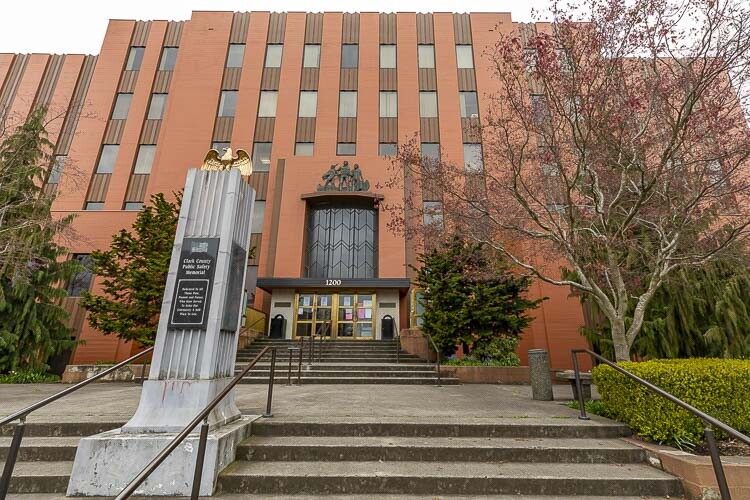
Clark County Prosecuting Attorney Tony Golik declines to explain the decision of his office, citing related current case
Ken Vance, editor
Clark County Today
The Clark County Prosecuting Attorney’s Office has decided not to file any criminal charges against an area resident, despite her admission to multiple instances of illegal voting.
An investigation by the Clark County Sheriff’s Office (CCSO) into Alexandrea Batman’s voting history revealed that she, a non-U.S. citizen, had registered to vote in Clark County in May 2000. The investigation was conducted by Det. Adam Beck and completed on Feb. 19, 2020. It revealed that over the years, Batman participated in 29 elections, including five instances since November 2015, despite not meeting the legal citizenship requirements for voting in U.S. elections.
This case, highlighting a significant breach of election law, constitutes a violation of RCW 29A.84.660, which deals with Unqualified Persons Voting, a Class C Felony in Washington state. Each unauthorized vote by Batman represents a distinct felony offense under this statute.
Batman openly admitted to these violations during the investigation. She acknowledged that she had read and signed the voter registration form, which clearly stated the requirement of U.S. citizenship for voting eligibility. Despite her lack of citizenship, she proceeded to vote in numerous elections over nearly two decades. She told a Clark County voting official she was not worried about getting into trouble.
The Clark County Prosecuting Attorney’s Office, after reviewing the case, opted not to pursue criminal charges against Batman, even though the investigation revealed she had voted illegally 29 times, including five times since November 2015. Therefore, the investigation revealed there was probable cause to charge Batman with five counts of the Class C Felony. It would seem this decision is sure to lead to public outcry and demands for a transparent explanation from the prosecutors.
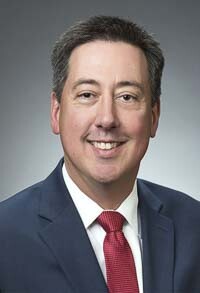
When reached by Clark County Today, Clark County Prosecuting Attorney declined to comment on the decision not to charge Batman, citing similarities to the current case the office is pursuing against legislative candidate John Ley.
“This is clearly related to litigation in another pending case (Ley), because of that, I’m not going to talk about the facts in this one (Batman),’’ Golik said by phone. “When that other pending case (Ley) is over I will be able to talk freely about this case (Batman) but since it’s clearly related to another pending case, I will decline to talk about this case today because of my standard obligation not to get into details of a pending case.’’
Ley was charged with allegedly registering to vote and as a candidate in an incorrect voter district. Ley was a Republican candidate for Washington state’s 18th Legislative District state representative Position No. 2 in 2022. Golik is a Democrat.
“The absence of criminal charges in such a clear-cut case (Batman) of repeated election law violations raises concerns about the equitable application of justice,’’ said Vancouver attorney Angus Lee, who is representing Ley. “Critics argue that this decision sets a concerning precedent and undermines the integrity of the electoral process. The Batman case stands as a stark example of the complexities and potential inconsistencies in prosecutorial discretion, highlighting a growing debate over the fairness and accountability within the legal system.’’
Lee has filed a number of motions in the Ley case, including a motion to dismiss. A hearing held in Clark County Superior Court on Jan. 9 featured some compelling comments from Judge John Fairgrieve, who essentially admonished the prosecution for its lack of preparedness and investigation that led to the charges against Ley.
Judge Fairgrieve, a former chief deputy prosecutor for Clark County, expressed concerns during the hearing about the completeness of the investigation, and noted the infrequency of such charges being brought and the challenges it presents. “These types of charges are very infrequent. First time I’ve actually seen these types of charges,” Fairgrieve stated. The judge acknowledged the unusual nature of the case and the unfamiliarity of law enforcement officers in investigating such matters, suggesting that this might have contributed to the oversight in the collection of evidence.
The next hearing in the Ley case is scheduled for Feb. 15.
The revelation of the Batman case would seem to increase the scrutiny on the decision of the Clark County Prosecuting Attorney’s Office to pursue charges against Ley.
In a letter dated Jan. 2, 2024 from Clark County Deputy Prosecuting Attorney Michael Vaughn, Batman was informed she would not be charged if she agreed to plead “Committed” to the infraction of Recklessly and Negligently Repeat Voting.
Also read:
- Former WA Supreme Court justice joins legal effort against income tax
 Phil Talmadge and Rob McKenna have joined forces with the Citizens Action Defense Fund to oppose Washington’s new tax on high-income earners, raising legal and constitutional questions.
 - Makeover in store for Congress with flood of lawmakers headed for the exits
 A wave of exits from Congress—over 65 lawmakers—will usher in unfamiliar faces and decrease veteran expertise, shifting the political landscape in Washington.
 - Opinion: Sheriffs fight back
 Four county sheriffs are suing to block a new law giving a governor-appointed board power to decertify and remove sheriffs, bypassing voter oversight in Washington.
 - Obituary for Lucille ‘Erma’ Christenson Madore – April 22,1924-March 13, 2026
 Known for her love of music and family, Lucille ‘Erma’ Christenson Madore lived through nearly 102 years and leaves a large, grateful legacy in Vancouver.
 - Fiscal fallout: $375 million bond debt indirectly funding operating budget
 Shifting $375 million from a loan fund impacts local infrastructure as Washington state covers operating costs with bond debt, prompting concern among officials and advocacy groups.
 - Lawsuit aims to block new eligibility requirements for WA sheriffs
 Four sheriffs are suing over a state law that sets new eligibility rules, arguing it undermines voter authority by allowing removal for certification issues.
 - Opinion: The growing gap between public voice and political power
 Todd Myers describes how large-scale protest and sign-ins often fail to sway state leaders, and argues authentic influence is most likely found through local action.
 wpDiscuz
