



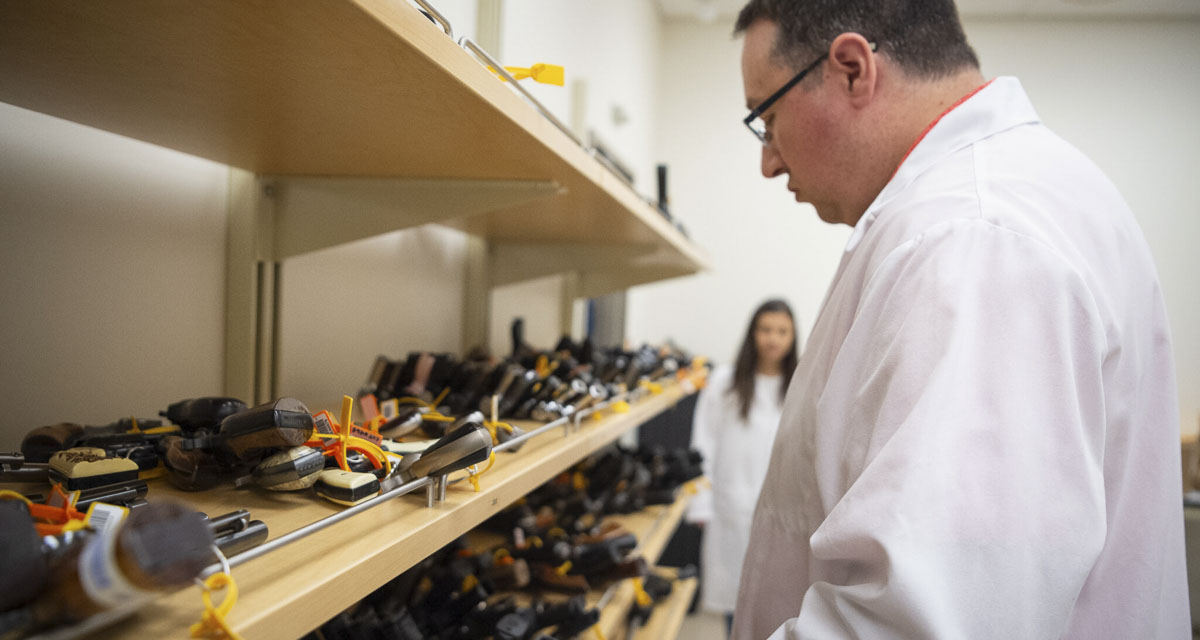
For the past four years, the state patrol’s forensic crime labs in Vancouver, Tacoma, Seattle and Spokane received an average of 628 requests for testing firearms per year
Jake Goldstein-Street
Washington State Standard
Police in Washington are sometimes waiting over a year for the state to test firearms evidence, as the Washington State Patrol deals with a growing backlog.
For the past four years, the state patrol’s forensic crime labs in Vancouver, Tacoma, Seattle and Spokane received an average of 628 requests for testing firearms per year, according to the state patrol. But the labs are only completing 418 of those requests annually.
The state patrol says it is making strides to address the issue, which can delay trials and hinder attempts to quickly find suspects.
As of July 1, over 950 cases awaited forensic analysis of firearms, with the current wait time stretching 54 weeks. The state patrol expects the backlog to peak at more than 1,050 cases this summer as demand for testing grows.
Larger departments can do some testing on their own. This is the case for the King County Sheriff’s Office, according to Undersheriff Jesse Anderson. The sheriff’s office, Anderson said, also uses the National Integrated Ballistic Information Network to examine bullet shell casings.
But for more technical needs, King County still relies on state crime lab scientists.
Tests can include matching a bullet found at a crime scene to the exact gun that fired it. Detectives can then try to track down that gun. Scientists can also try to decipher serial numbers that a person attempted to remove from a gun to help find its owner.
But getting results back from the crime lab can take anywhere from six to 18 months, said Anderson, a former detective.
“Demand continues to grow. It doesn’t go down, it just continues to increase,” he said. “The challenge for all law enforcement agencies and forensics labs is just to be able to keep up with that workload and the expectations that the prosecutors have for building these cases.”
While awaiting testing, police and prosecutors may still have enough evidence to charge suspects, but have to wait to go to trial. In other cases, the forensics may be key to developing leads detectives can follow up on to track down a suspect.
In the past couple years, the crime lab added eight forensic scientists focused on guns, doubling capacity. But it takes two years to train them, said state patrol Chief John Batiste.
Half have completed their training and are examining firearms. As of early August, two more were on track to join the ranks this month, and the other two are expected to finish training by the end of the year.
“The bottom line is that the number of cases where firearms play a part in criminal activity has grown, and we must restructure and grow our forensics capacity,” Batiste said in a statement. “This is a process, not an event. But we are getting closer to meeting our needs every day.”
Once all the new scientists are on board, state patrol expects to reduce its firearm backlog by 35% by next July, and 60% by January 2027. The goal is to consistently finish testing within 120 days by 2028.
Anderson said he thinks the crime lab “is doing what they can to try to keep up.”
“This is just going to be a challenge all the time,” he said.
Washington State Patrol has also faced backlogs in blood toxicology as well as DNA testing, specifically for sexual assault kits. The state auditor said in December that the backlog of sexual assault testing kits had been “effectively eliminated.”
This report was first published by the Washington State Standard.
Also read:
- VIDEO: WA income tax signed into law with legal challenge right behind
 A 9.9% income tax affecting high earners in Washington faces swift legal opposition and a proposed citizen initiative seeking repeal.
 - Income tax signed in Washington with a legal challenge close behind
 A new law will tax households earning over $1 million, with funds aimed at expanding credits for lower-income residents. Lawsuits and challenges are already underway.
 - Peter Silliman announces candidacy for Clark County Council
 Peter Silliman, small business owner and Charter Review Commissioner, is seeking the District 5 seat and promises action on transparency, housing, and park development.
 - Opinion: Defend bail now or face more chaos on our streets
 A proposed Washington court rule would cap bail for most misdemeanors and allow defendants to bypass bondsmen, raising concerns about accountability and public safety.
 - County seeking young people to fill 10 volunteer positions on Youth Commission
 Young people ages 12-19 from across Clark County can now apply for at least 10 open seats on the Youth Commission, providing input on community decisions.
 - State Representatives McClintock and Ley answer questions at town hall in Battle Ground
 Residents voiced rising concerns about property taxes, school funding debates, the impact of new income tax legislation, and major costs tied to the Interstate Bridge plan.
 - As Washington gets an income tax, the fight to overturn it begins
 Opponents are organizing lawsuits and potential ballot measures to challenge the new 9.9% income tax on Washington households earning over $1 million.
