



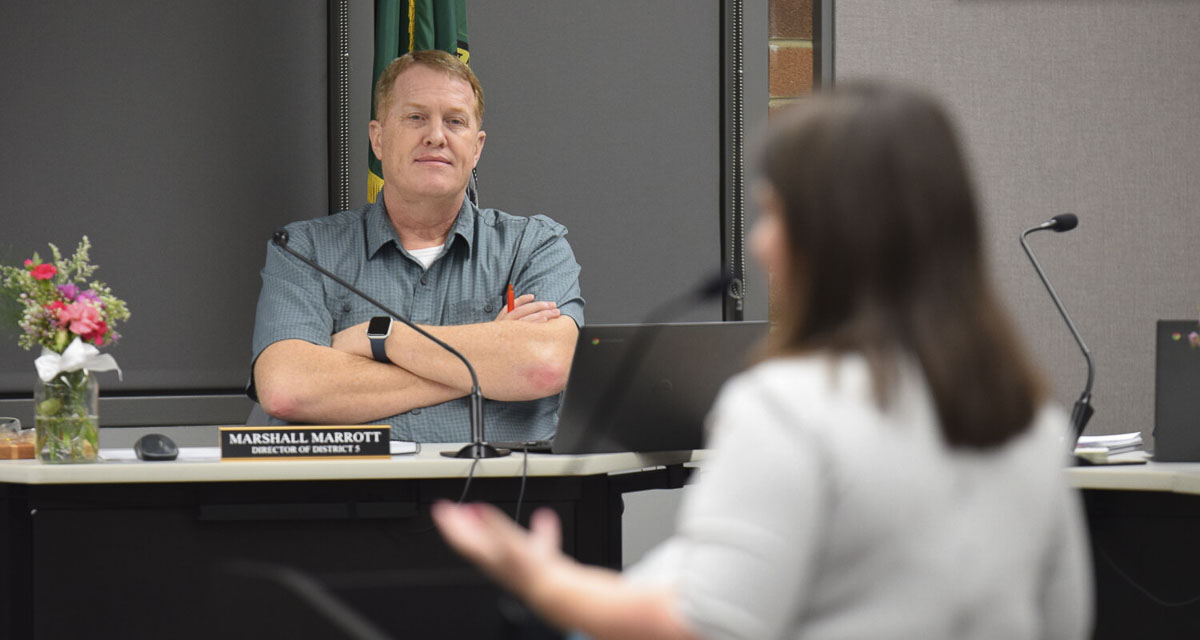
At a Monday, Feb. 23 workshop, Superintendent Shelly Whitten and the Board of Directors discussed what comes next, including up to $20 million in cuts
Norman Helgeson
The Reflector Newspaper
Battle Ground Public Schools leaders are staring down another round of deep reductions after voters rejected the district’s educational programs and operations levy for a third time during the Feb. 10 special election.
At a Monday, Feb. 23 workshop, Superintendent Shelly Whitten and the Board of Directors discussed what comes next, including up to $20 million in cuts.
After a second levy failed last year, the district cut $13 million. Those reductions eliminated all middle school sports and coaching positions, free school supplies for primary grades, Kindergarten Jump Start, instructional coaches and teacher librarians. The district also reduced crossing guard shifts, nursing and mental health roles, consolidated bus routes, delayed curriculum purchases and scaled back the ASPIRE magnet program by removing its third-grade cohort.
Now, district leaders must identify an additional $20 million in cuts by April 27. They will have one more opportunity to place a levy before voters later this year.
About 85 percent of the district’s budget is staffing, with the remainder covering operating costs. The district operates 19 schools and serves roughly 13,000 students. Between 2021 and 2025, the district faced a $66.72 million gap between state funding and the cost to provide safety and security, substitute coverage, special education, sports and other extracurricular programs.
About 85 percent of the district’s budget is staffing, with the remainder covering operating costs. The district operates 19 schools and serves roughly 13,000 students. Between 2021 and 2025, the district faced a $66.72 million gap between state funding and the cost to provide safety and security, substitute coverage, special education, sports and other extracurricular programs.
Throughout the workshop, Whitten said the financial pressure is forcing the district to sort through state requirements and determine what is truly protected from cuts.
“There are some things, some anomalies in what is mandated and what people think we can cut and what we actually can. And so I think the balancing act will help us be transparent about what those things are and what they aren’t, because we’ll have to lock the things that you can’t cut from,” she said.
While administrators detailed budget realities, students and staff urged the board to consider the human cost.
Sixth grader Benjamin Goldstein spoke about his experience in the district’s ASPIRE program for highly capable students and asked board members to preserve it.
“First, from previous cluster experience, the experience was not the best. I would finish assignments fast, and then I’m not met with the learning I need. I met with sitting on a Chromebook doing things that are still too easy and not at my level. The only thing that challenged me was daily math challenges, and they still weren’t challenging for my personal beliefs. And if I do go back to the cluster program, I will most likely have to skip a grade,” Benjamin Goldstein said.
He also described feeling unsafe outside the program.
“The only safe space we have is in our ASPIRE classrooms, and I cannot bear to imagine what would happen if I am in a class with… bullies,” Benjamin Goldstein said.
Student board representative Itzel Contreras Montiel shared results from a student survey conducted at Chief Umtuch Middle School, where 191 students participated and submitted 246 comments and thousands of ratings. She said roughly two-thirds of respondents feel supported by staff, while about half said they or their classmates feel affected by the levy failure.
She said even younger students understand what is at stake.
“Fifth-graders who you may think they should not know about money, about budgeting, about what’s being taken from them, about what they’re going to lose, for them to speak to me and just and rant about all the things that they care about is… just a little disheartening just because me and (Student Representative Toby Nguyen) always come to these board meetings and we do all these surveys, and we try to make such a huge impact by showing you what groups of kids from around our district are seeing are being affected. And we don’t want these to go in one ear and out the other. We want these things to be implemented,” she said.
Ashley Stoker, a substitute teacher who has worked in the district for four years, urged the board not to reduce school security staffing.
“I’m here tonight to give my opinion that our security team cannot be one of these areas to keep our students safe on campus,” Ashley Stoker said.
She described incidents that required immediate help.
“Two weeks ago, a knife was pulled in my class, and again, I rely on safety and security and having additional backup in a team to help support me and keep the kids safe in the classroom on our school campuses,” Ashley Stoker said.
District staff also reviewed early versions of the state’s supplemental operating budget during the workshop, cautioning board members that proposals from the governor, House and Senate would move funding in the wrong direction if adopted as written.
Going into the legislative session, the district and other school systems had requested full funding for substitute teacher costs, more equitable staffing ratios and additional special education support. Instead, administrators said the initial proposals fall short in several areas.
One significant concern is a proposed change to school bus depreciation schedules. Under the plans, the state would extend the number of years districts must depreciate their buses, shifting smaller buses from an eight-year schedule and larger buses from 13 years to a longer 15-year standard. For Battle Ground’s fleet of 156 buses, that change would mean keeping vehicles on the road longer, increasing maintenance costs and reducing annual revenue tied to the district’s transportation funding structure by about $300,000.
Staff also flagged potential cuts to transitional kindergarten funding. Early budget drafts range from roughly $19 million to $39 million statewide, which district officials said could translate to reductions of 25 percent to 50 percent in that program area.
Administrators emphasized that the proposals are not final and that districts across the state are actively advocating against reductions as the legislative process continues. In the meantime, at least one costly state requirement could see relief.
In a prior interview with The Reflector, Whitten described how House Bill 1248, which addresses benefits for contracted bus drivers, left the district responsible for about $2 million after the state failed to send the expected funding. That cost landed after the district had already adopted its budget, forcing leaders to rely on local levy dollars to cover the gap.
Following the Monday workshop, State Sen. Adrien Cortes, who represents the 18th District, said funding to address Battle Ground’s transportation benefit gap is included in the Senate’s proposed operating budget. The proposal has passed out of the Senate Ways and Means Committee but must still move through the legislative process as of press time.
According to Whitten, the district has repeatedly contacted the Office of Superintendent of Public Instruction and legislative budget committees about the mandate and its impact. District leaders have also met with several local lawmakers and shared the issue with legislators during a November forum with superintendents from the Education Service District 112 region.
This report was first published by The Reflector Newspaper.
Also read:
- Battle Ground Public Schools face $20M in cuts after levy failure
 Battle Ground Public Schools leaders are preparing up to $20 million in additional cuts after voters rejected the district’s levy for a third time.
 - Letter: The Missing Skamania Report – The prosecuting attorney is still sitting on it
 Rob Anderson questions why an investigative report into potential County Charter and OPMA violations has not received an outside review after being declined by multiple offices.
 - Public Works employees recognized by Neighborhood Associations Council of Clark County
 Eric Lambert, the Clean Water Outreach Manager, and Hunter Decker, the Clark County Forester, were recognized in a ceremony in front of the Clark County Council on Tuesday Paul ValenciaClark County Today Two Clark County employees were officially recognized for their service during a Tuesday presentation by the Neighborhood Associations Council of Clark County (NACCC). …
 - SCOTUS rules against California’s ‘secret gender transition’ law
 The U.S. Supreme Court ruled 6-3 against a California policy allowing schools to withhold information about a student’s gender identity from parents, finding likely First and Fourteenth Amendment violations.
 - Opinion: Washington’s charter schools deliver – if the state lets them
 Vicki Murray argues that Washington’s charter schools are posting stronger academic results than comparable peers while facing funding inequities that are shrinking the sector.
 - Vancouver Public Schools kindergarten enrollment for 2026-27 school year now open
 Vancouver Public Schools has opened kindergarten enrollment for 2026-27, with applications for Choice schools and programs due by May 11.
 - Commission on Aging offers opportunities to advocate for older residents and more livable communities
 Clark County is accepting applications through March 31 for open seats on its Commission on Aging, which oversees the Aging Readiness Plan and focuses on mobility and housing in 2026.
