
Regional Transit Serving People

Kevin Peterson
PHASING Transit for Purpose
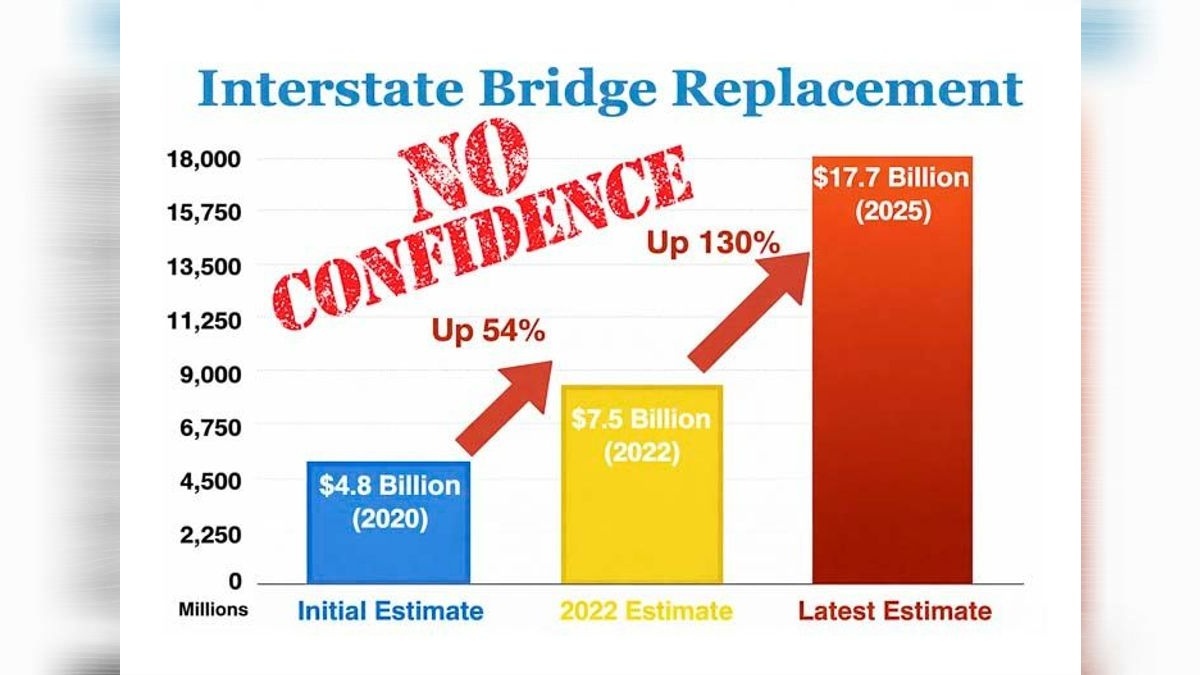
Many are now discussing phasing the $14 billion Interstate Bridge replacement project. This includes a redo of multiple interchanges as well as a bridge. A road project embracing many freeway miles is now being discussed as a phased effort.
Well … what about high-capacity transit? How might transit crossing the river best influence regional mobility? Let’s consider a phased effort consistent with the freeway phased effort.
Allow me an introduction. My career includes planning and/or design of more than 600 high-capacity transit infrastructure improvements for more than 50 cities throughout the world. What you’re reading is a four-continent perspective that has helped a hundred urban places “walk the talk” of meaningful transit/development integration. From this experience I’ve learned two basic goals that guide transit investment policy. First, effective high-capacity transit needs to satisfy a meaningful percentage of regional trips. Secondly, transit should improve the quality of life for all people. Simple measurable goals.
These basic goals do not seem part of the transit discussion in the Portland metropolis.
This lack of clarity does not mean the two goals are not desired. I suspect these goals might have simply been “sidetracked” in the 40 years since LRT moved into the Portland metropolis transit tool kit.
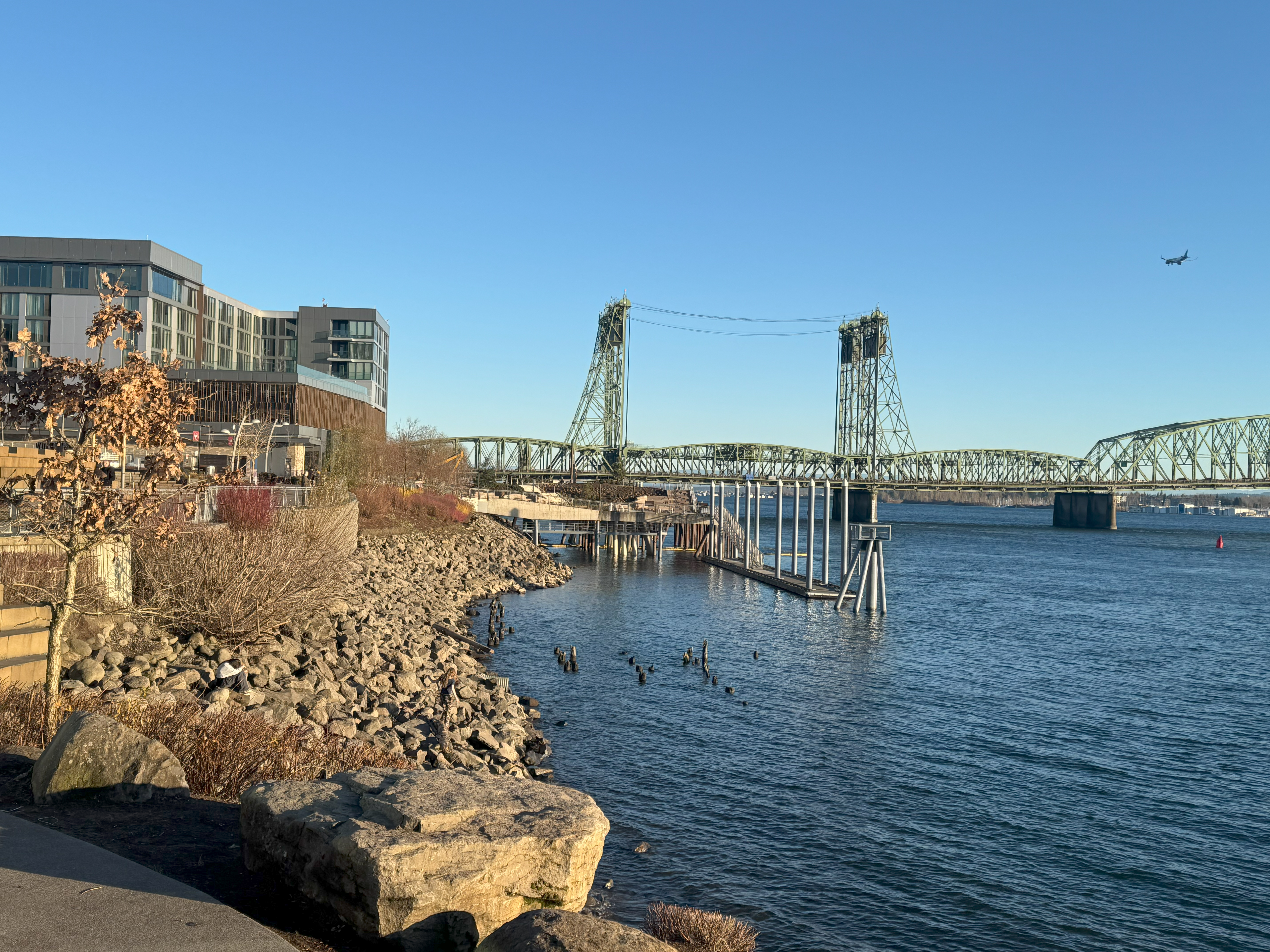
The phrase “fit for purpose” guides application of these goals as investments (projects) and policies (politics) find value in what we do. A consistent saying amongst engineers is “fit for purpose.” No clear overarching guide can be found for the I-5 investment reflecting “fit for purpose” consistent with the two basic transportation goals. One station on the far shore of the Columbia River, proposed in the 2.5-billion-dollar Interstate Bridge Replacement Program (IBR) transit project component, only lands transit in Clark County with a single station. The need, or phasing implication for LRT, is to move off the north beach into Clark County to be a valuable transit tool. Advancing high-capacity transit into Clark County suggests phasing. How is this done compatible with the two foundational goals of transit?
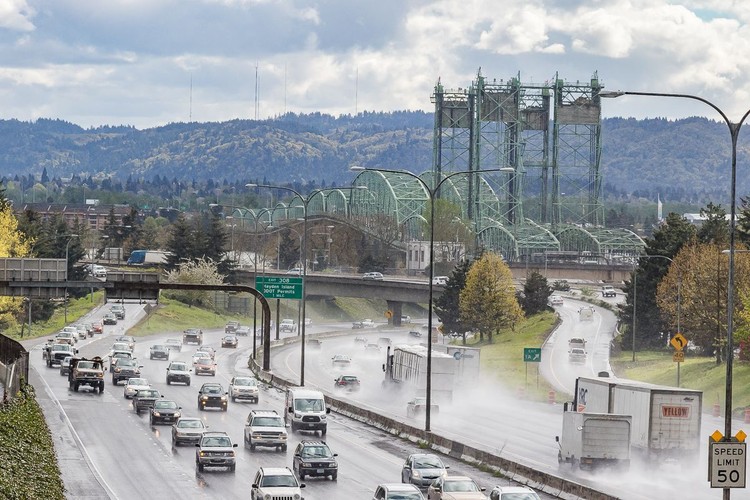
Today the transit mode share for people crossing the Columbia River is a paltry 1.5% to 2% of corridor trips. Let that reality sink in. 98.5% to 99% of those crossing the Columbia River do not employ transit in the metropolitan community. For a community that identifies itself as advocates of transit this is sad. This reality tells me transit is not a meaningful mobility choice. Historically, transit in North America moved a much higher percentage of urban trips. For example, in the 1950s and 1960s 8% to 10% of Portland urban trips employed transit.
I assume transit advocates desire transit that serves more people by taking on a greater percentage of metropolitan trips. I suspect this was the motivation for Portland’s light rail development late last century. I also suspect LRT advocacy finds value with political leadership presently promoting light rail into Clark County.
Let’s honor this desire by considering long-term transit mode share for the I-5 corridor.
Let’s “walk this thought.”
In my opinion, a future with transit utilization at par with transit friendly North America cities is a reasonable reflection for transit goals in the Portland metropolis and can be a ‘fit for purpose’ measure for phasing transit into the I-5 corridor. For example, transit utilization goal might be two thirds the transit utilization in New York, the city in North
America where 30% of trips employ transit. A goal twice a typical east coast city where the transit mode share typically serves 8% to 12% of metropolitan trips also seems reasonable.
Given what I sense from Portland transit advocates, serving 20% of I-5 corridor cross-river trips would meet the two fundamental goals of transit.
This, of course, begets a host of policies supporting urban density and mobility actions complementing a transit friendly, more urban, I-5 corridor. The second goal, achieving a better-quality place to live and work, is a subject that requires a word count more than this article allows. Let’s simply assume the progressive community will also “walk the talk” of a denser, transit-friendly, highly desirable and attractive urban corridor.
This future is not a simple car versus transit debate. Transit will evolve as an integral component of a transport system that advantages many modes and technologies. This future requires consideration of self-driving cars, high-efficient private vehicles, more polycentric trips (polycentric is many urban activity areas in the metropolitan area), and, given deficient spending and tax obligations of the last half century, fewer public dollars likely available for infrastructure. For example, imagine a future with self-driving electric cars that form trains which can double or triple how many people are moved in one freeway lane. Transit also needs to overcome time, comfort and safety anxieties of users now reluctant to move about in a vehicle shared with dozens of strangers. These are but a few challenges policy makers will deal with that simply cannot be confidently understood today.
Let’s next explore what a 20% transit mode share implies if phased. Let’s also touch on costs and impacts. First, let’s look at LRT as the foundation technology for transit in the I-5 corridor and used to move most transit trips.
Let’s also assume the I-5 corridor grows by 50% in five decades. Remember, we’ve assumed a growth projection reflected in land use policies supporting focused development complementing high-capacity transit tied to a rail system. This suggests more activity in downtown Vancouver and several focused urban sub-centers likely served by several transit stations/centers and park-and-ride facilities throughout Clark County.
Let’s also assume this growth compliments the existing street grid and matures today’s activity centers. This is simply growing what we have today such that citizens live a better life and advantage transit.
In 2020, 8,800 peak hour vehicles crossed the Columbia River on I-5 traveling in the peak commute direction. At 1.3 people per vehicle with a 50% growth over the next 50 years, this translates to 17,000 peak direction people crossing the river in a commute hour. If
Light Rail Transit serves 20%, policy leaders need to anticipate a train capacity serving up to 3,400 peak direction transit trips each commute hour.
What does this suggest for transit if TriMet’s LRT Yellow Line meets this demand? In 2025 the Yellow Line had 1,500 daily passengers traveling in the peak direction at the Pioneer
Courthouse station. Typically, 10% to 15% of daily users travel in the peak direction during the peak commute hour suggesting +/- 200 peak hour passengers are being served by the
Yellow Line, or something like +/- 300 passengers per hour if ridership increases by 50%.
This means rail transit technology employed south of the bridge and north of downtown
Portland will be asked to serve an hourly flow of 3,700 passengers in the peak direction.
Two-car trains, each having a 200-person capacity (135 seated and 65 standees per train, or about 80% of the ‘crush load’ for a train during the peak hour), suggests a peak commute hour need for 20 trains traveling in the peak direction. This suggests a peak direction train will cross the river every 3 minutes. The train fleet needed for this service looks like a 45- train fleet; 2 to 2.5 times the 20 trains of the two-hour round-trip. With a 20-year service life and $10 million per train cost expect a $450 million investment. Operating costs of $400 per train per hour for the 45-train fleet suggest $20k every hour, or something like $200,000 a day.
How is this done? Implementing Yellow Line LRT operations able to achieve a 20% mode share, is a unique ‘fit for purpose’ phasing challenge due to technical realities of 3-minute headways. Presently, this train frequency is not possible because:
- 1. multiple lines sharing the same at-grade tracks in mixed traffic roads of downtown
Portland precludes this frequency,
- 2. nor is it possible to operate 3-minute headways in mixed-traffic within the residential/commercial mixed-traffic street grid of north Portland, and
- 3. LRT line(s) running into Clark County will require multiple transit station/hubs and many miles of train track.
When train frequencies exceed six-minutes operating in mixed traffic is not done. This is because any one train requiring a longer dwell (station or intersection) will have a ripple effect delaying following trains resulting in overcrowded trains followed by undercrowded trains. Two wheelchair passengers boarding at one station likely triggers a 10 to 20 second delay resulting in a downstream delay of a couple minutes as each following station stop has more boarding passengers requiring a longer dwell time. For instance, Japan copes with this using white gloved agents politely pushing passengers into packed trains. Imagine nearly packed trains slowing trudging through residential streets or downtown Portland.
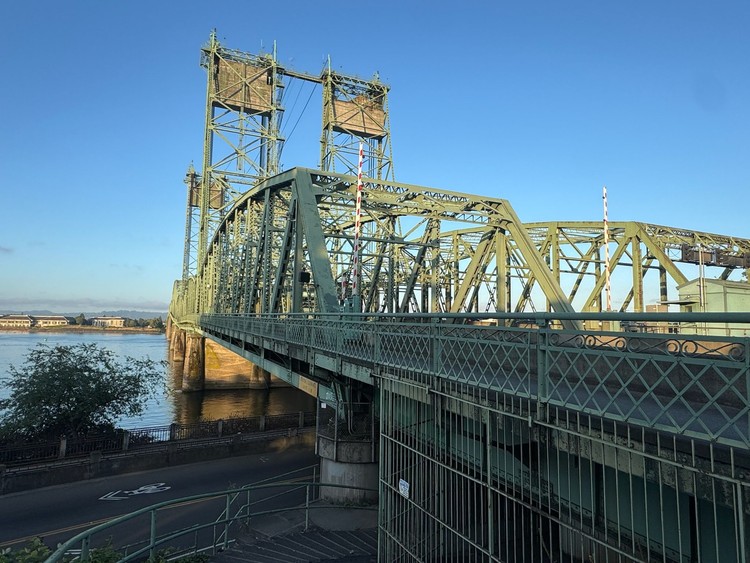
The easy part of this LRT investment, which looks to be phase one, is the $2.5-billion LRT bridge across the Columbia River.
What policy leaders should appreciate is this future requires all three post I-5 bridge project phasing actions before a 20% transit mode share across the Columbia River is possible. Accomplishing three out of the four means slow, less frequent trains and a policy not achieved. An overview of these four ‘phases’ brings these realities to policy makers:
- First: Grade separated transit operations look to be necessary in downtown Portland.
Imagine a one to two-mile underground line with up to four stations. $15 to $20 billion, or more, and a half decade of construction disruption will be required. The solution may be to underground the east-west LRT line consistent with earlier studies by TriMet. This allows the Yellow Line to achieve four-minute headway on surface streets of downtown Portland with improved throughput likely to include priority signaling and street restrictions. TriMet will need to underground either the east/west line or the north/south line, my guess is undergrounding the east/west line makes more sense as this line is easier to accommodate four car trains and more frequent headways. For example, the preliminary design of the Washington Park station, the deepest underground station in North America, was selected partially because it can be altered to accommodate four-car trains. If north/south and east/west lines are undergrounded, then double this $15 to $20 billion cost!
- Second: Eliminate most, if not all, mixed traffic operations in the Yellow Line. Imagine shifting the Yellow Line to I-5 for the 4 to 6 miles of North Portland. Anticipating a new
Willamette River bridge may be required. This likely requires a half dozen years of construction and 4 to 8 billion dollars.
- Third: build the I-5 LRT bridge. 2.5 billion needed.
- Fourth: Extend the Yellow Line deeper into Clark County to serve more transit-oriented communities and park-and-rides. Imagine one, possibly two, LRT lines reaching urban sub-centers. This easily requires five to eight stations and ten miles of alignment.
Anticipate a couple decades of construction and 5 to 10 billion dollars.
As we all know, sorting out phasing, routes, costs, and thousands of other considerations is a challenge in the USA. This suggests an institutional discovery phase easily requiring a decade or two to sort out.
With LRT the metropolitan community should anticipate spending $25 to $45 billion, or more, over multiple decades. 50 years is a reasonable guess of how long this will take
(remember it’s taken three decades to just get a 60% design for the I-5 bridge).
By doing this the region achieves a north-south I-5 corridor with a transit capacity able to serve one in five people moving between Vancouver and Portland. Additionally, if policy makers are smart, planning this future for four-car trains can achieve a remarkable 30% mode share for little additional investment with a more reasonable six-minute headway.
Utilizing LRT means an effective high-capacity transit future is secured for the I-5 corridor.
However, can the region absorb the cost and time needed to make this happen? Will trains even be competitive in fifty years when we know mobility technology is changing? Can security and safety be achieved to ensure passenger acceptance? This future is problematic. Many will call LRT investment a high-risk prospect. Simply introducing self-driving energy efficient electric cars forming trains throws a wrench in this future.
Remember, LRT requires all four phases before a rail transit mode share can grow beyond today’s less than satisfactory transit utilization, maybe reaching 4% to 5% if one or two of these major projects are accomplished. Also, assuring transit sensitive development is problematic for as long as the region does not commit the many billions needed for logical
LRT phasing. This means transit-friendly urban growth during the next five decades is a risk for as long as these phases are not accomplished. No developer will want to build if parking is restricted with transit being decades away.
What development can happen if mobility needs are not satisfied? Too risky. In Clark
County this risk can be partially mitigated using buses operating along future LRT routes.
However, these buses will need to run to Portland until LRT is fixed in downtown Portland and North Portland. Let’s also assume trunk bus routes are convertible to LRT.
This interim bus reality may be ‘quietly’ understood by local leadership. For example, is
Clark County, with the VINE bus line, looking to buses to support transit friendly development? Without the four LRT investments, buses will likely be called upon to make up most of the transit capacity in the I-5 corridor over the next five-plus decades. However, Clark County actions are dependent on TriMet improving the Yellow Line and making huge transit changes in downtown Portland. Expecting a tram operating in mixed traffic to mature into a high-capacity rail transit line is a huge cost and big risk.
I’m perplexed to not see this phased transit plan not in the public whelm. Are leaders unaware, in denial, or simply not wishing to share what phasing means for transit?
This begs the question, “How can transit more quickly help transit friendly urban development and be achieved at less cost and risk?”
Is a less risky and costly transit technology able to serve 20% of cross river trips possible?
Ideally, the transit technology employed should grow hand-in-glove with greater density, minimizing risk developing transit friendly communities. Vancouver’s Vine Line suggests this future.
What should this technology accomplish:
- 1. Integrate in a timely manner. Capacity that works hand-in-glove with transit supportive development helps minimize development risk allowing logical redevelopment actions. High-capacity transit and urban density working hand-in-glove in Clark County over a fifty-year period if easily phased and understood.
- 2. Work with today’s transit distribution system focused on downtown Portland.
This recognizes that transit is now focused on downtown Portland although the urban environment is evolving into a polycentric community. Transit technology should cope with this evolving polycentric urban fabric simultaneously focused on downtown Portland and the other dozen urban subcenters that make up the metropolitan urban fabric.
- 3. This system is best developed incrementally and much less dependent on
‘mega’ projects. Orchestrating $35-plus billion in incremental infrastructure funding is a huge undertaking for institutions presently challenged finding the funds for a single bridge. This is especially poignant given today’s social-economic need for public resources, greater local, state, and federal governmental obligations that look to require even more funding, and significant public debt imposing what amounts to a $400,000 mortgage on the average taxpayer household. The ideal transit technology should minimize risk due to mega-project funding uncertainty and/or challenges asking local taxpayers to support huge investment based on a future employing murky ‘transit’ crystal ball predictions.
Buses operating in mostly exclusive lanes become an obvious alternative. What is required to accommodate 3,700 transit passengers each hour moving in the peak direction suggest for a Bus Rapid Transit (BRT) system? Imagine several dedicated bus lines within Clark
County feeding across the Columbia River using prioritized BRT lanes in I-5. This suggests extending and maturing the Clark County VINE line north of the river, I-5 with viable bus lane provisioning, and a distribution plan in downtown Portland connecting with other transit routes serving the polycentric urban fabric.
Let’s assume a mixed fleet of articulated and standard buses allowing all passengers to sit
(compared with 25% of train passengers required to stand). With an average of 65 seated passengers per bus, a little over 60 buses each hour will likely be needed; a bus every fifty seconds. The running time of buses looks to be between 30 and 45 minutes, maybe 30% to
50% faster than LRT operations in mixed traffic. Remember, the LRT Yellow Line continues to operate as a tram in North Portland with a capacity that matches need and operational constraints of mixed traffic. Each bus requires 1.25 hours for a return trip, suggesting a +/-
100 bus fleet. However, buses need to be replaced twice as frequently as LRT vehicles.
This suggests 200 buses are needed over 20 years. At $1 million per bus, this suggests a
$200 million investment (compare this with $450 million for LRT vehicles). With operating costs of $200 per hour per bus, an ongoing $20,000 peak hour expense is expected
(nominally equal to LRT, possibly less as trains operate mostly empty during non-peak periods). A Bus Rapid Transit line (BRT) does seem logical, but what’s the capital investment required?
BRT capital infrastructure costs
Without any studies as a guide, BRT costs and construction disruption are but educated guesses. Here’s my guess:
- 1. Enhance downtown Portland bus streets. Let’s assume a $500 million to one billion investment in downtown Portland for a transit hub and/or enhanced bus distribution system. Possibly one street in downtown Portland may need to be dedicated to BRT.
- 2. Improve/create BRT lanes between downtown Portland and Vancouver on I-5.
Maybe $500 million to $1 billion? Possibly more if a new Willamette bridge is needed. Let’s assume a $500 million to $1 billion bridge is needed. I-5 BRT using dedicated lanes on I-5 might require $1 to $2 billion.
- 3. Create BRT/HOV lanes and hubs into Clark County. Let’s assume three BRT routes with three or four transit centers per route. Maybe $50 million per ‘transit center’ and $200 to $300 million for each route. This is nominally $700 million to $1 billion for BRT distribution within Clark County.
That’s a big range. $2 billion to $3.8 billion needed to achieve a 20% transit mode share across the Columbia River.
Compared with LRT, BRT can be implemented quickly. A decade to plan, design, and build this system is reasonable. Anticipate comparatively, and significantly, fewer negative environmental and social impacts compared with LRT.
Electric BRT technology energy consumption looks to be less than LRT, possibly a reduction from .05 kWh/km per passenger to .033 kWh/km per passenger. Construction related environmental impacts look to be less. A better environmental solution is likely.
A perceived negative to BRT is how transit-friendly urban density is influenced, achieved or served. BRT and LRT both serve dedicated routes that can foster transit-oriented development. However, many feel LRT encourages greater density near stations as stations are less frequent than BRT stations, spaced every one-half to one mile. BRT can serve varied densities as stops can be placed nominally at quarter mile spacing. Both can work. BRT has the advantage of more easily maturing existing urban areas with less disruption. The important takeaway from this is the need for good planning.
Conclusion
BRT can be done much more quickly and therefore has greater potential for creating transit-friendly communities in our lifetime as LRT looks to take a half century before complementing transit-friendly densities. My observation is only BRT has a meaningful impact achieving transit-friendly communities over the lifespan of an adult.
- With BRT, all passengers are seated – no passenger is expected to stand.
- BRT guideway/road capital costs look to be one tenth the cost of LRT. Let that sink in. One tenth of the LRT cost achieves the same 20% mode share.
- LRT vehicle cost is twice that of buses.
- More long-term local employment opportunities, like drivers, are likely to result from
BRT.
- More money is kept local as construction and design does not require the exporting of financial resources to import design and construction talent.
This choice is so obvious as to raise the question why the region is now dead set spending
$2.5 billion to augment a bridge for a tram that begets dozens of billions to be spent with future phasing. Compare this with BRT serving up to 20% of I-5 corridor trips for what we’re now willing to spend just to land trains on the north shore of the river.
Comfort, sustainable local employment, phasing, quality-of-life, transit supportive development, and cost implications needed to achieve a respectable transit mode share should inform leaders that the current LRT proposal is not a viable choice. BRT is the clear choice. However, considering how volatile mobility technology is, I’d advocate for a bit of design discipline. BRT should be designed to be readily converted to LRT operating four-car trains by 2100. This is what Seattle did last century.
Today, I sense two extreme views dominate discussions regarding the role of transit, much less phasing implications. Love or hate trains; love or hate cars. Butting heads with no clear and common sense of the transit role simply does not improve mobility. Logical thinking should be employed.

Comments
Loading comments…