
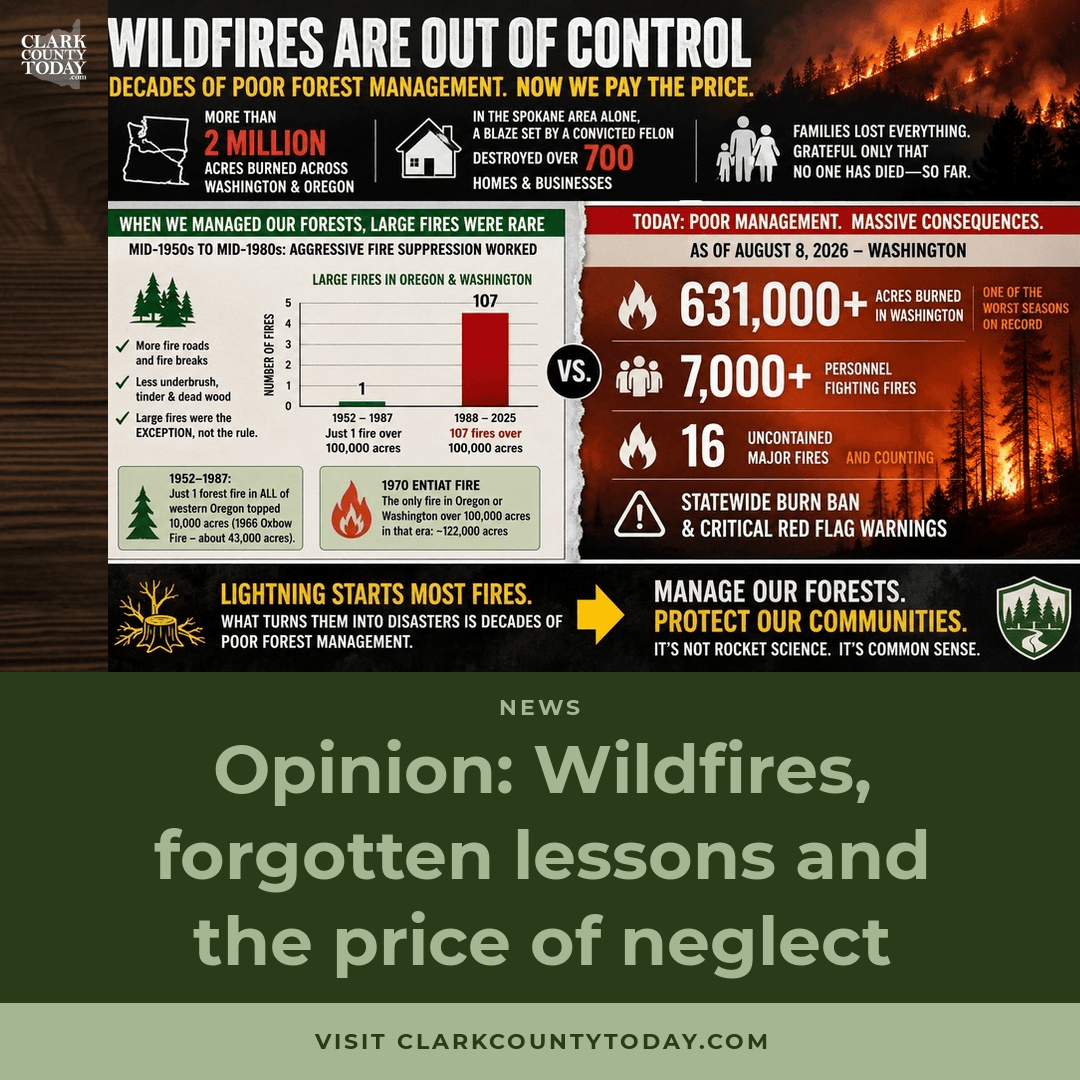
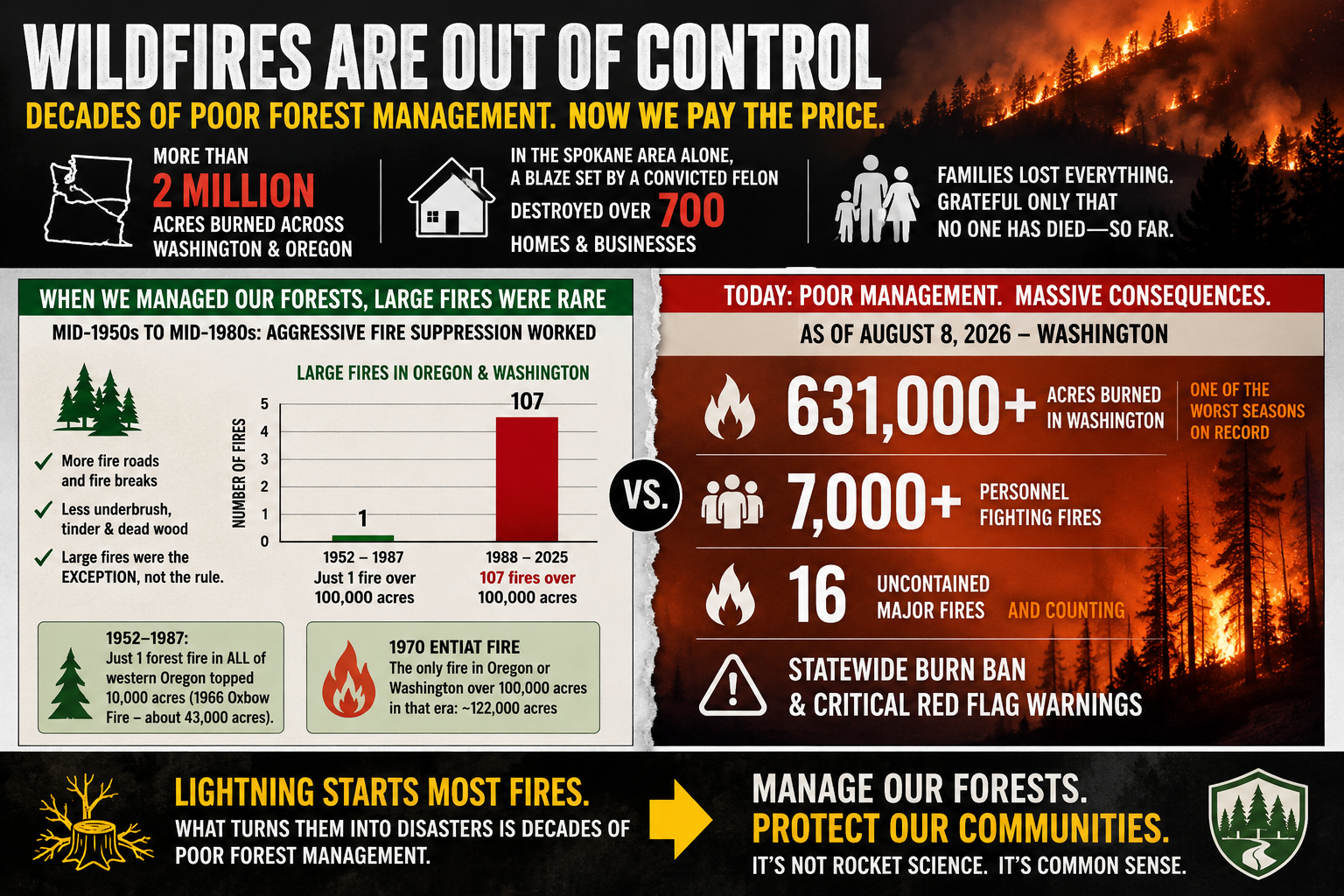
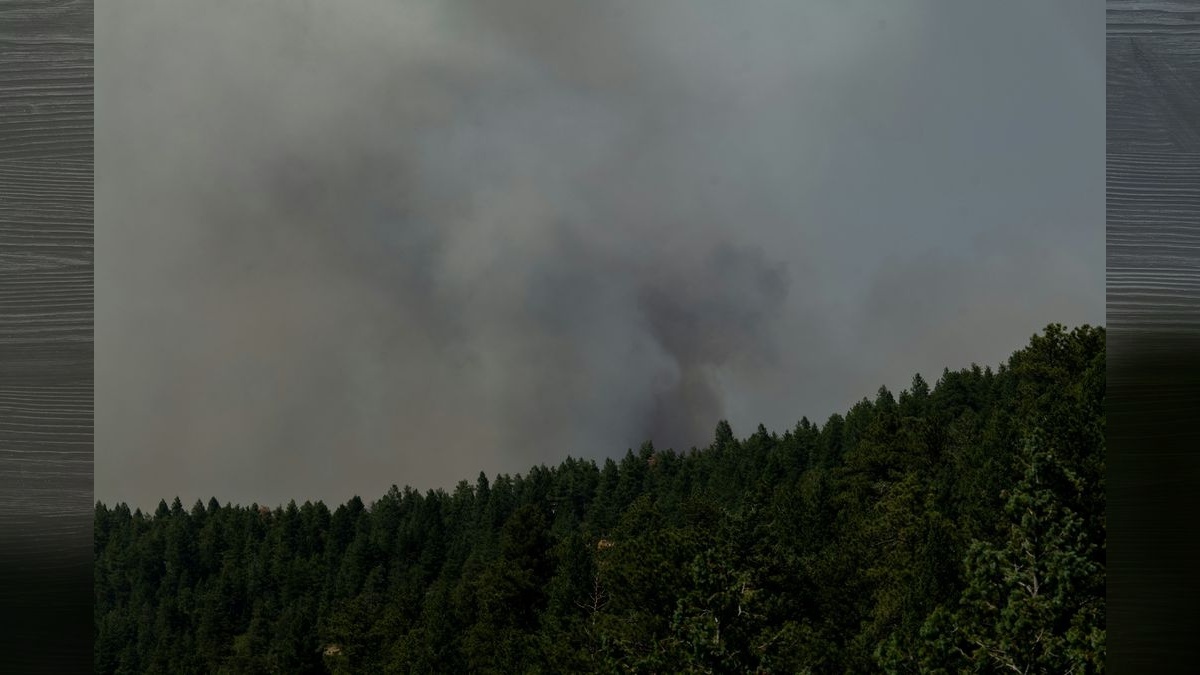
Wildfires are devouring more than 2 million acres across Washington and Oregon. In the Spokane area alone, a blaze set by a convicted felon has already destroyed over 900 homes and businesses. Families who lost everything sit in shock, grateful only that no one has died — so far.
Lightning still starts most wildfires. What turns them into runaway disasters is decades of poor forest management: too few fire roads and fire breaks, and far too much underbrush, tinder, and dead wood waiting to explode.
History is not subtle on this point. From the mid-1950s through the mid-1980s, aggressive fire suppression in the Pacific Northwest kept large blazes rare. In those decades only one fire in Oregon or Washington exceeded 100,000 acres — the 1970 Entiat Fire at roughly 122,000 acres. Between 1952 and 1987, just a single forest fire in all of western Oregon topped 10,000 acres (the 1966 Oxbow Fire at about 43,000). Large fires were the exception, not the rule. We somehow forgot what worked.
The numbers today are brutal. As of August 8, 2026, Washington is enduring one of its worst wildfire seasons on record, with more than 631,000 acres already burned. More than 7,000 personnel are fighting 16 uncontained major fires under a statewide burn ban and critical Red Flag Warnings.
How will the state help the families who lost homes and livelihoods? What resources can it actually put on the ground? And what must change so this does not become the new normal?
Michael Medler, a professor of environmental studies at Western Washington University who studies the geography of fire, puts it plainly: “The numbers don’t lie. Even the way we describe wildland fires has changed: We used to talk about them in acres, now we use square miles. A huge fire back in the ‘80s was 50,000 acres; now it takes 300,000 or more to move the needle.”
One news report put it this way. Every one of the ten largest US wildfire seasons on record has happened since 2004. An area the size of five Yellowstone National Parks is routinely burned annually, and those numbers are continuing, on average, to climb.
The fuel load is staggering. “We’ve got 400 million acres in need of thinning right now — today,” Medler says. “That’s roughly the size of Alaska, and to do that would take, no exaggeration, 10 million people, full-time. Not going to happen. Right now the Forest Service is thinning about half a million acres a year… We’re not going to fix this with chainsaws. The only thing that will fix it is fire.”
Medler’s prescription is practical. Clear quarter-mile buffer zones around high-risk communities in the eastern Cascades foothills and places like Spokane. Hire more fire managers and mitigation specialists. Checkerboard the forests near population centers with carefully planned prescribed burns so the next lightning strike or arsonist does not find a continuous carpet of fuel.
Timber harvesting belongs in the same conversation. Selective cutting removes fuel, creates fire breaks and access roads for firefighters, supports rural jobs, and generates tax revenue that has largely vanished. Skamania County once had six lumber mills; it now has one. Timber once supplied more than half of state and local revenue and employed nearly two-thirds of Washington’s wage earners. By the 1950s it still contributed 5–10 percent of state revenue.
After the northern spotted owl listing and subsequent federal timber harvest collapses of 85–90 percent, that contribution shrank to less than 1 percent. Trees were exempted from property taxes in 1971; harvesters now pay a 5 percent forest excise tax. Allowing more responsible harvest would reduce fuel, create jobs, and put real money back into county and state coffers that firefighters desperately need. It would provide the tax dollars to pay for decades of neglect in our forests.
Then there is the pollution these megafires dump into the atmosphere. A 100,000-acre fire can release 2.5 million to 9 million metric tons of CO2 plus tens of thousands of tons of fine particulate matter, depending on forest density and soil. A million-acre fire can emit nearly as much greenhouse gas as the entire state of Washington produces in a year — about 96 million metric tons.
By comparison, the Climate Commitment Act has reduced emissions by roughly 78,000 metric tons while extracting some $5 billion from Washington households and businesses. At that rate of reduction it would take decades — potentially more than a century — to offset the carbon released by this year’s fires alone.
We can and must do better. The families who lost homes and businesses deserve more than sympathy. The rest of the state deserves a forest policy that remembers what once worked, restores active management, and stops treating catastrophic fire as inevitable.
Rep. John Ley represents the 18th Legislative District and he sits on the House Environment and Energy Committee.

Comments
Loading comments…