


Jason Mercier
When considering ballot measures, voters need access to accurate details about the possible fiscal impacts of a proposal. This is why, like for legislation debated by lawmakers, a fiscal impact statement should be available. Pro and con arguments about the policy should also be readily available in the voters’ guide. An informed and honest policy debate is in everyone’s best interest.
What should not occur, however, is placing prejudicial and severely limited government-prescribed fiscal language directly on the ballot next to a proposal.
This is why a longtime government transparency advocate, Arthur West, has filed a lawsuit challenging the language added by government officials to the ballot proposal in Washington state to repeal the new and yet-to-be-collected 9.9% income tax.
West’s ballot language lawsuit focuses on these main arguments: “Four independent constitutional and statutory theories support the relief requested: the right of petition guaranteed by Article I, section 4; the people’s reserved legislative power under Article II, section 1; the separation of powers doctrine, which protects the people’s coordinate lawmaking function on the same structural terms this Court’s own recent precedent uses to protect the Legislature’s; and, in the alternative, RCW 29A.72.027’s own statutory command that the disclosure be neutral.”
As reported by Washington State Wire: “A 2022 law requires disclosure statements of 15 words or less be placed on ballots if a measure repeals, levies or modifies a tax or fee, and if it would cause a net change in state revenue.”
The disclosure statement in question for the income tax repeal proposal would add this suspect language to the ballot: “This measure would decrease funding for public K-12 education, higher education (including universities and community colleges), and human services (primarily healthcare).”
The new 9.9% income tax in question, however, is not scheduled to take effect (assuming it survives constitutional legal challenges) until 2028, with revenues not collected until 2029. How does repealing a brand-new income tax that won’t be collected for another three years impact any government services today? It doesn’t.
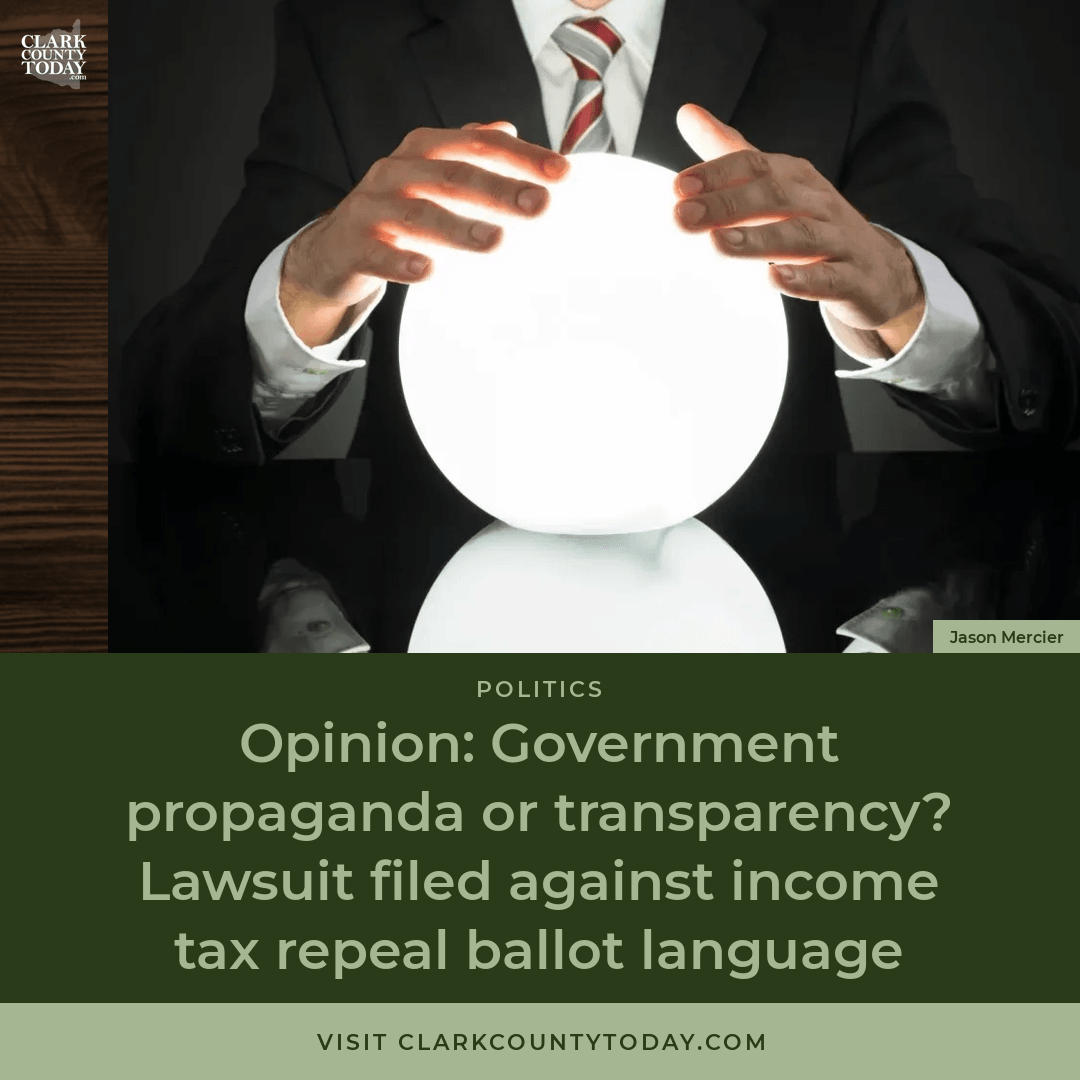
This dubious crystal-ball fiscal clairvoyance has dismayed policy experts and government transparency advocates.
Former state Senator Lynda Wilson, a long-time ranking Republican on the Senate Ways and Means Committee, said about the proposed government-added ballot language: “This is government-sponsored advocacy masquerading as neutral ballot information. And it creates a deliberately uneven playing field. The tax has not collected a single dime and will not produce revenue until 2029 . . . That is not an honest debate. It is the government putting its thumb on the scale at the expense of the very people it is supposed to serve.”
Ryan Frost, Budget and Tax Director for Washington Policy Center, astutely noted: “The tax doesn't even take effect until 2028. Revenues don't come in until 2029. So, no current school district, college, healthcare system, or hospital has any funding that depends on any of this revenue, because it doesn't exist yet. How are we cutting education with money that doesn't exist yet? I hope that that's a question that pops into voters' heads when they're looking at their ballot.”
This concern about the mandated government-added language to tax ballot measures extends far beyond the current income tax debate. Unless revenues are constitutionally protected (like the 18th Amendment restrictions in Washington for the gas tax), there is no such thing as dedicated funding for education, healthcare, or higher education. The entire back of the budget is littered with legislative fund raids from “dedicated” accounts.
Instead, Washington tax revenues are available for lawmakers to prioritize when writing the budget using their constitutional appropriation authority. Unless constitutionally defined, no law or ballot measure can bind what a future legislature does with its appropriation power.
If future lawmakers in 2029 decide to reduce spending on K-12 education, colleges, or healthcare, they will do so of their own volition, not because of something voters decide today.




Comments
Loading comments…