
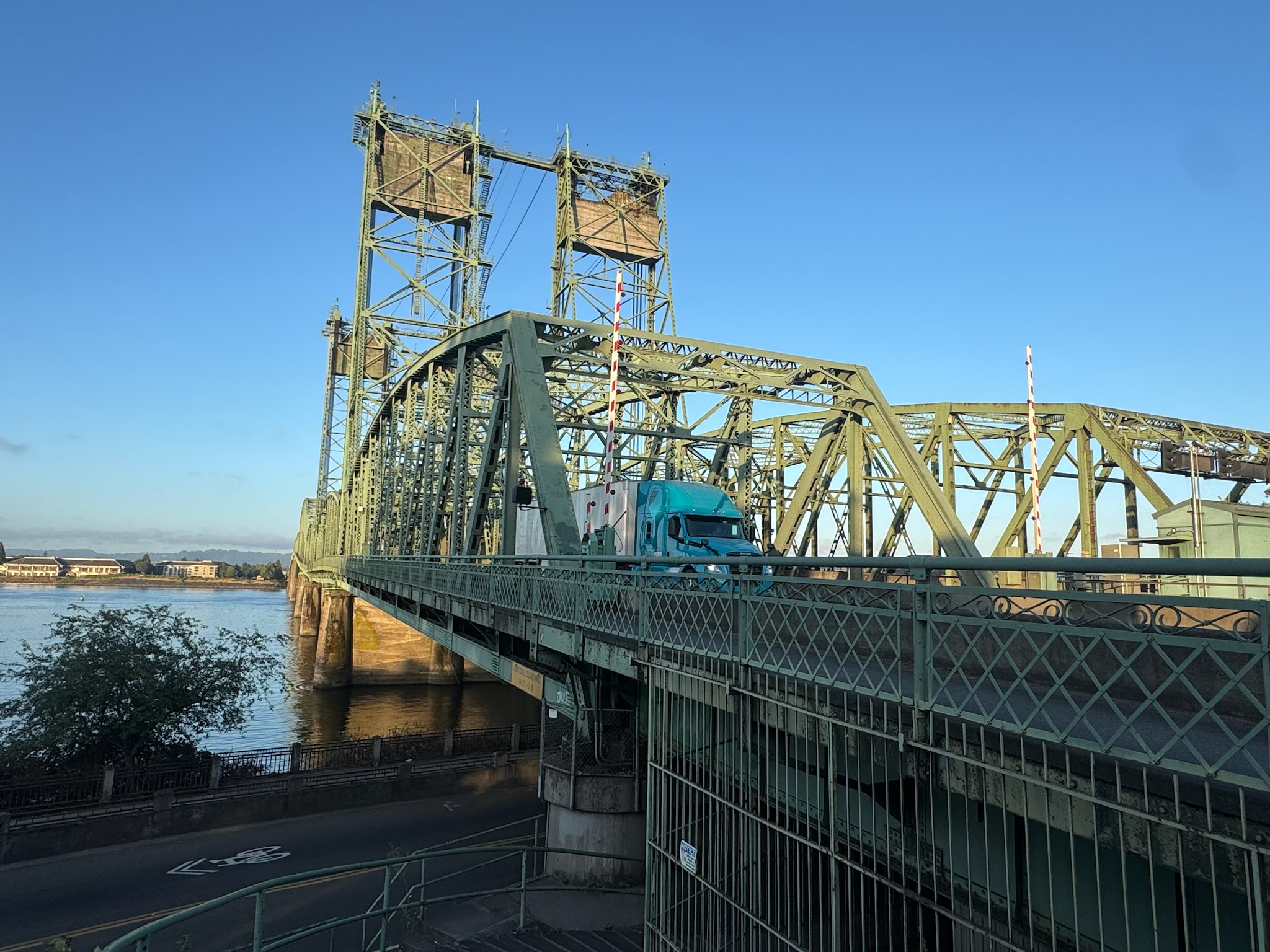
The I-5 bridge, built on spans dating to 1917 and 1958, carries 140,000 vehicles and $132 million in goods daily. Photo by Andi Schwartz
This federal approval clears the way for Washington and Oregon to begin identifying a contractor and securing permits to replace the Interstate 5 bridge over the Columbia River
VANCOUVER – The Interstate Bridge Replacement Program (IBR) received federal approval today (July 1), completing its federal environmental review. IBR officials report the approval allows the program to move toward construction. Specifically, this federal approval clears the way for Washington and Oregon to begin identifying a contractor and securing permits to replace the Interstate 5 bridge over the Columbia River.
The Federal Highway Administration and Federal Transit Administration issued an Amended Record of Decision for the Interstate Bridge Replacement Program Wednesday (July 1). This step marks the completion of federal National Environmental Policy Act review. The milestone is the result of decades of planning and coordination between Oregon and Washington to replace the I-5 Bridge connecting Portland and Vancouver, one of the most vital and vulnerable structures on the West Coast. The decision follows the April 17 publication of the Final Supplemental Environmental Impact Statement.
“A new Interstate bridge is essential to Washington and Oregon,” Washington Governor Bob Ferguson said. “It’s critical for our economy, public safety and the thousands of good-paying jobs it will provide. This approval is a major milestone that allows us to get moving. We are committed to building this bridge. I’m excited to get started.”
The current Interstate Bridge is among the oldest river crossings on the West Coast, with spans dating back to 1917 and 1958. The current structures are built on timber piles driven into sandy soils that elected officials and transportation leaders believe are at risk of collapse during a major earthquake. The bridge currently carries more than 140,000 vehicles and $132 million in goods each day. It serves as a critical link for commuters and national and regional economies. A replacement bridge is designed to address long-standing safety and seismic risks, improve mobility for all travelers and strengthen the freight network.
“With this approval, our focus is squarely on execution — advancing procurement and ensuring the systems and structures that megaprojects of this scale demand are in place as we transition to construction,” said Washington Transportation Secretary Julie Meredith. “Our bi-state partnership continues, and we are drawing on proven experience to build the tools and oversight needed to deliver this project responsibly and efficiently. We are ready to take this first step toward turning the vision into reality, and we will work closely with our partners and the public every step of the way.”
The investments and design options that advanced through the federal environmental review reflect years of public and technical input. The program coordinated closely with partner agencies, consulted with federally recognized tribes, and engaged with elected officials, advisory groups and communities across the region — including residents throughout the program corridor, commuters, transit users, the freight and maritime industries, and community organizations.
"Reaching an Amended Record of Decision reflects years of detailed study in coordination with our local and federal partners, including responding to over 9,000 individual public comments," said Carley Francis, interim IBR Program administrator. "We now get to go do the work of actually building this bridge."
Next steps
In the coming months, the IBR Program will complete work to secure the necessary permits to begin construction and obligate the remaining grant funding. With the Amended Record of Decision in hand, the program will advance a first funded phase of construction with the $5.7 billion in available local, state and federal funding. This first phase includes:
Replacing the existing Interstate Bridge with a new, more earthquake-ready bridge providing a shared-use path and space for future construction of light rail.
Connecting the replacement bridge to I-5 in Oregon and Washington.
Connecting Hayden Island and SR 14 to I-5.
Advancing transit system design in alignment with federal transit grant requirements.
Building toll infrastructure to begin collection in 2028.
Removing the existing Interstate Bridge.
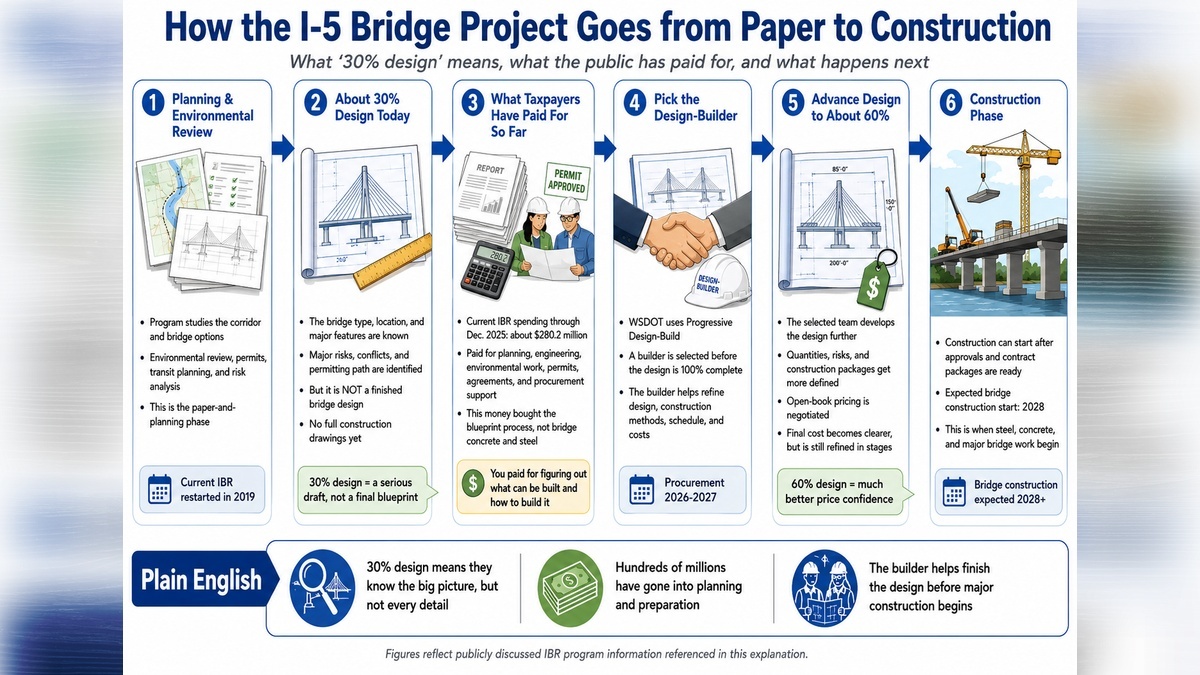
The IBR Program is preparing to issue a request for qualifications in the coming weeks to begin the process of identifying a contractor for the Columbia River Bridge Replacement project, which will include the replacement bridge and adjacent connections. A request for proposals will be issued later this year with a contractor expected to be hired in 2027.
Information in this report provided by the Interstate Bridge Replacement Program.
Comments
Loading comments…