
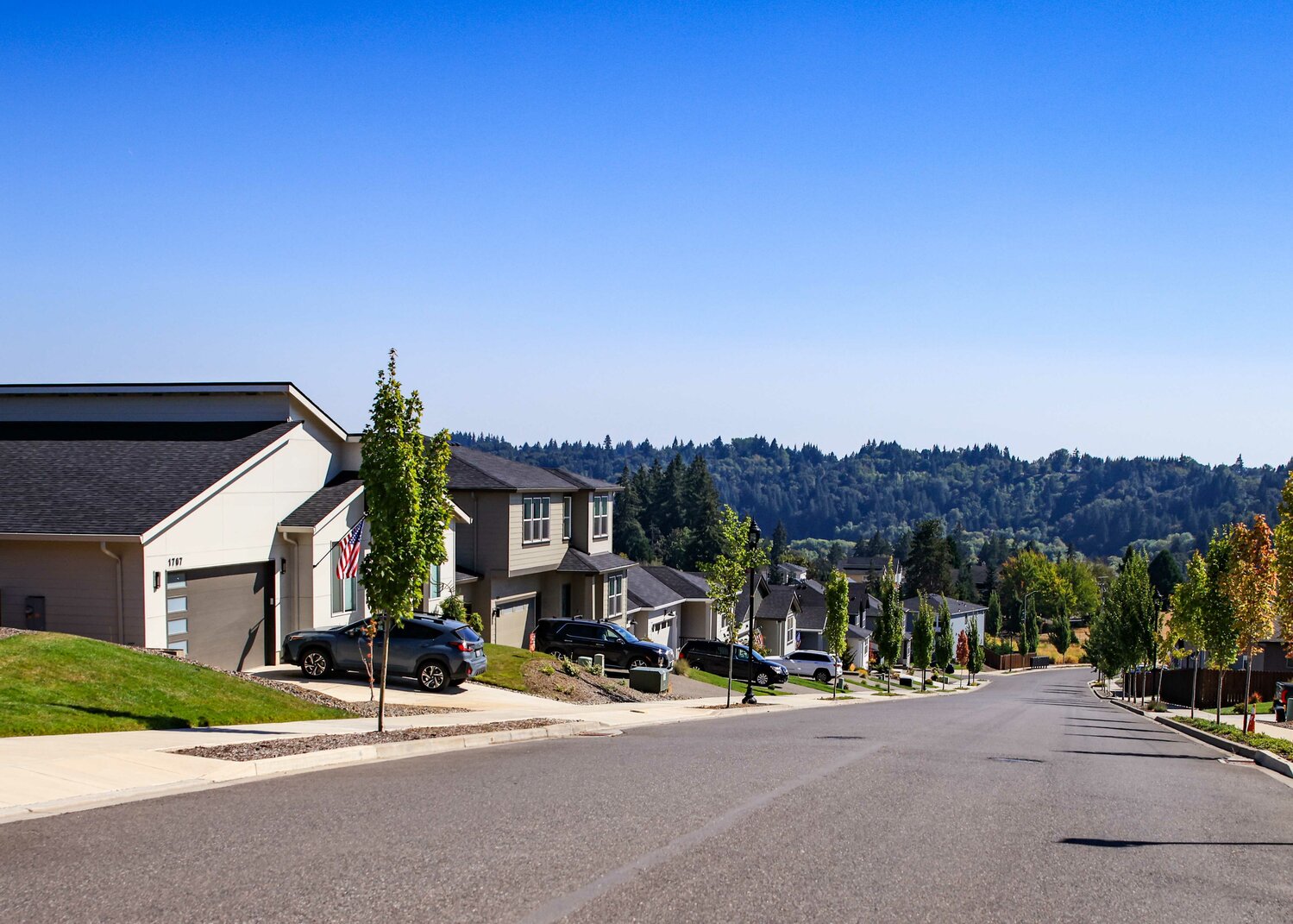
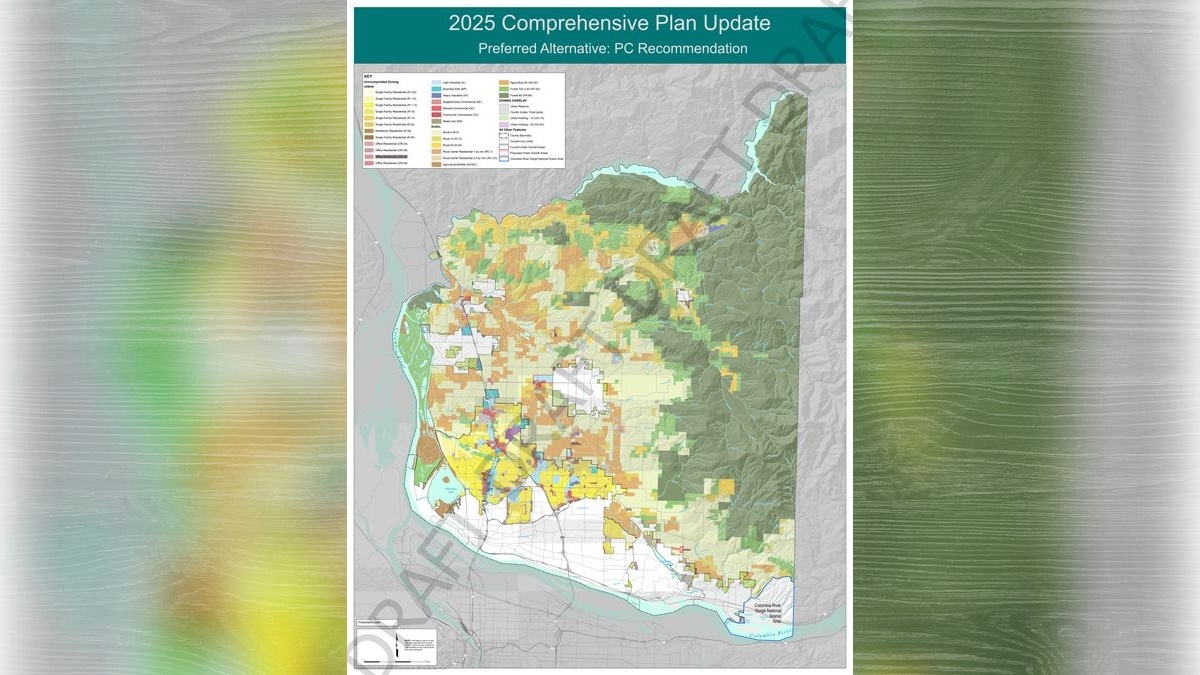
A proposed update to Clark County’s 2045 comprehensive plan is setting the stage for continued growth across the county, with Battle Ground, La Center, Ridgefield and Yacolt each taking different approaches to where — and how much — their communities should expand.
The comprehensive plan is a long-range policy document required under the state’s Growth Management Act that guides Clark County and its cities in planning for population growth, employment, housing and land use through 2045.
A representative of Battle Ground, La Center, Ridgefield and Yacolt spoke to the Clark County Planning Commission during a public hearing for the 2025 Comprehensive Growth Management Plan Update.
The cities’ positions were presented during a Clark County Planning Commission hearing on the county’s preferred land-use alternative, with discussions centered on urban growth area expansions, housing capacity, employment and preservation of agricultural land.
Battle Ground seeks westward expansion over south
The county’s preferred alternative includes roughly 488 acres of urban growth area expansion around Battle Ground, while excluding a larger 327-acre area known as Meadow Glade that the city had requested for inclusion. The difference leaves about 161 acres of additional expansion in the preferred plan compared with the city’s full request.
The Battle Ground portions of the plan have also raised questions among commissioners about the long-term implications of shifting growth toward different portions of the city’s urban growth boundary.
The main argument for the transition, said by Sam Crummett, Battle Ground planning supervisor, can be seen simply on a map. Roadway infrastructure in Meadow Glade is not readily available to accommodate job growth like state Route 502 between current city limits and the Dollars Corner area already can.
One commissioner, Ron Barca, questioned whether removing an area from the urban growth area while planning for westward employment growth could simply create pressure to add the land back later.
“My concern is it fits the purposes of this particular growth plan at this particular moment, but it isn't really long term planning,” Barca said.
La Center seeks growth while preserving small-town character
La Center’s priorities focused on balancing growth with the preservation of the city’s small-town identity.
City Planner Angie Merrill told the commission that the city supports exploring and implementing a countywide transfer of development rights, or TDR, program for agricultural lands.
Merrill said conversations with residents and stakeholders repeatedly identified three priorities: maintaining La Center’s small-town feel, directing growth toward the Interstate 5 junction where transportation and infrastructure can support it, and creating family-wage jobs.
“So La Center does not become simply a bedroom community,” Merrill said.
The La Center City Council unanimously adopted a preferred alternative that calls for targeted growth around I-5, as well as downtown and the Timmens Landing Subarea.
“We believe this approach provides opportunities for needed housing and employment while preserving the character that makes the center special,” Merrill said.
The preferred alternative includes about 121 acres of potential La Center urban growth area expansion. The city also asked to bring an additional parcel owned by Clark Public Utilities into the urban growth area so it would not remain as an isolated “donut hole.”
Merrill said La Center views a TDR program as a way to address competing demands for development and farmland preservation.
“At this time, we believe we need to be innovative, and we need innovative tools that allow us to accomplish both goals,” she said.
Ridgefield supports targeted expansion
Ridgefield City Manager Steve Stewart said the city supports the preferred alternative because it aligns with the community’s vision developed through the Envision Ridgefield 2045 comprehensive planning process.
The city’s proposal emphasizes directing density toward areas where existing infrastructure and services can support growth rather than broadly increasing density throughout the city.
“It does so by targeting our density in the places where it makes sense, using mixed use hubs that have the services and amenities to support them primarily within our existing boundaries,” Stewart said.
The preferred plan includes approximately 239 acres of Ridgefield urban growth area expansion. Two primary areas discussed by the city include a roughly 14-acre property surrounded by the city’s urban growth area and a North Industrial Urban Reserve that has been designated for future industrial and job growth since 1994.
Stewart said the targeted expansions could provide opportunities for affordable housing and jobs while limiting the pressure on existing neighborhoods.
Ridgefield also joined La Center and Camas in supporting the development of a countywide TDR program, which could allow development capacity to be transferred in a way that preserves commercially viable agricultural land.
“We remain committed to that concept,” Stewart said. “We remain committed to the connection between this expansion and a TDR program.”
Yacolt questions housing capacity
Yacolt took a different position, asking the Planning Commission to correct what town representatives said was an inaccurate accounting of the community’s residential capacity.
Allison Baker, a planner with Jackson Civil representing Yacolt, said the town does not support the preferred alternative’s treatment of its residential land capacity.
Yacolt’s concerns stem from a 20-acre parcel that was developed into 47 homes, consuming land the town had previously counted toward its 150-unit housing allocation through 2045.
An earlier draft of the environmental impact statement proposed a 90-acre Yacolt urban growth area expansion that included residential and employment growth. Under that version, Yacolt showed a 118-unit housing surplus.
The final environmental impact statement reduced the expansion to 12 acres for employment only, eliminating the residential component. Baker said that change resulted in the town going from a reported 118-unit surplus to a seven-unit deficit — a 125-unit swing.
“And we couldn't find an explanation for the change,” Baker said.
Baker said county records show the 20-acre parcel was subdivided into 47 lots in January 2024 and sold the following month individually. She said a county map used for the preferred alternative still showed the property as vacant, while a more recent map showed it as built out.
Yacolt therefore questioned whether the housing-capacity calculations rely on outdated information.
“Disclosure matters for transparency and understanding, especially when considering a change that determines whether Yacolt has room to grow,” Baker said.
She said Yacolt already has limited housing inventory and that lots sell quickly, creating concern that insufficient capacity could contribute to higher housing costs or development pressure outside the town.
This report was first published by The Reflector Newspaper. Cade Barker can be reached at [email protected].


Comments
Loading comments…